
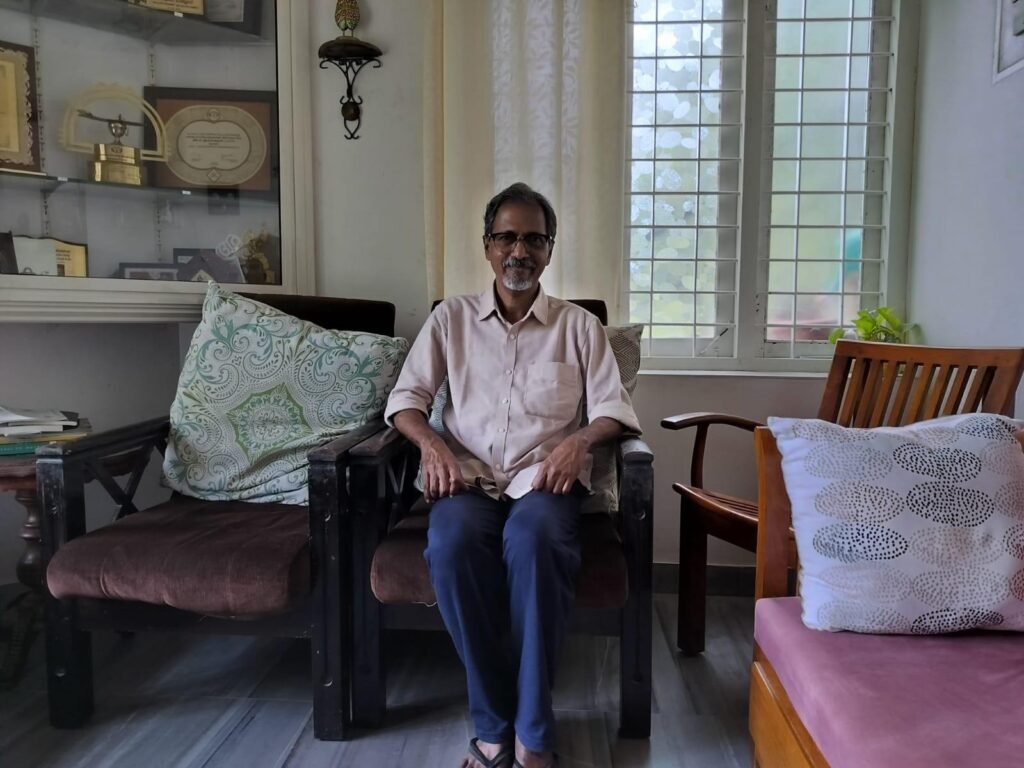
P.F. Mathews in conversation with Grace Mariam Raju, discussing his literary writings and fond memories of growing up in the port city of Kochi, Kerala.
Introduction
Poovankery Francis Mathews is a contemporary Malayalam writer who hails from Kochi. Growing up in Kochi, Mathews was inspired by the port town’s cosmopolitan history and littoral geography, and his creative disposition is deeply rooted in his Latin Catholic community’s syncretic living. Besides fiction, he has written screenplays for the Malayalam film and television industries. He received the state television award for Mikhayelinte Santhathikal (Descendants of Mikhayel) in 1993. He also won the National Film Award for Best Screenplay for the film Kutty Srank in 2010. However, Lijo Jose Pellissery’s film, Ee.Ma.Yau., brought him critical and popular recognition as a screenplay writer. His novel Chavunilam (1996) gained him recognition as a fiction writer in Malayalam. This was followed by other works such as Theerajeevithathinu Oru Oppees (2013), Irritul Oru Punyalan, Pathimoonnu Kadalkakkakalude (2018), Kadalinte Manam (2021), Muzhakkam (2021), and Moonga (2024). He won the Kerala Sahitya Akademi Award for his novel Adiyalapretham in 2021. P.F. Mathews’ writings depict the littoral world of Kochi and its inhabitants through themes of death, religion, folklore, environment, and caste. He invokes the language, legends and syncretic culture of the Catholic fisherfolk community and also brings alive ecological spaces such as the backwaters and backwater islands. By combining myths, faith, ecology, and the banality of everyday living, P.F. Mathews engages with the cultural world of people who are located at the margins of Kerala’s society.
Interview
Grace Mariam Raju: Since the release of your first novel, Chavunilam in 1996, you have consistently explored Kochi in all your literary and creative endeavours. However, Chavunilam continues to be a significant work that delves into the historical, cultural, geographical, political, and ecological issues of Kochi. How did you develop your perception about Kochi as a writer, having been born and raised here, and having written all your works while living here?
P.F. Mathews: Any form of literary writing is developed through the writer’s own perception, which forms the core value of that literary text. So, when we read mythological stories, or any fiction, we may feel that the writer has deliberately constructed the literary world of the text, but that is not the case entirely. The literary world of the writer emerges in the process of writing as well as in the process of placing that literary text within the larger socio-cultural context. In my experience, I perceive Kochi very differently from what other people perceive, experience, or understand Kochi. I am often labelled as a magical realist writer; however, I don’t agree with magical realism as a literary genre being attributed to my work. My literary universe is based on my experience of Kochi, which is locale specific and has its roots in the non-urban Kochi. I have never tried to create a magical realist perception of the coastal town. I have understood Kochi through its ordinary people, backwaters, backwater islands, its flora, language, and stories that I have heard while growing up.
Grace Mariam Raju: I agree with your perspective. Chavunilam should not be read as a magical realist novel, given its socio-cultural world establishes the idea of archipelagic Kochi. So, the idea of thuruthu, or the backwater island, plays a significant role in understanding your literary world, along with elements of myth and fantasy that you incorporate into the narrative, testifying to your experience of the place as distinct from how Kochi has been portrayed in mainstream films. What inspired you to write about the island world and its inhabitants in Chavunilam?
P.F. Mathews: Elements of fantasy in any piece of writing are supposed to supplement the writer’s imagination and perception. Having said that, no writer would deliberately construct or create elements of fantasy or myth to write a story. It is the perception, experience, and elements of folk and oral cultures that together combine to create an affective imagination, and the writer eventually develops a distinct style of narrative. However, I never think of incorporating magical realism into my writings. I have developed my literary imagination through my experience of Kochi during my childhood. Although we imported magical realism from Latin America, we must also recognise that our own magical realities are distinct and different from those of the Latin American Boom. This reality is our own and emanates from our cultural context. So, for example, in a Catholic household in Kerala, there is something called Vannakamasam Pusthakam. I have grown up reading and reciting the Vanakkamasam Pusthakam, where there are stories about saints, demons, miracles, divinities and divine interventions that have shaped my culture, language, faith and imagination. During our formative years, we all have grown up listening to stories. Similarly, I also had a grandmother; we used to call her “Ammacho.” She would share stories about saints and demons. So all of those stories I grew up hearing introduced me to legends and mythical figures, which I believe is difficult to be encapsulated in the generic idea of magical realism. Thus, all of the oral stories had a significant impact on my work, particularly on Chavunilam. So, Chaavunilam is inspired by the stories that I have heard and inherited from my grandmother and other elderly people, as well as my experiences about living in Kochi’s island villages.
Grace Mariam Raju: Most of your literary works are rooted in the ordinary, everyday experience of Kochi’s backwater islands. Your portrayal of Kochi shows another side of the port town, away from its historical prominence of being the mercantile centre of maritime trade. You have not obliterated Kochi’s heritage and historical past but you tend to focus on the ordinary, everyday banal living with the grandeur history of the port town. In this regard, your fictional world engages with the invisible elements that constitute Kochi’s cosmopolitan culture and thereby signals at an inherent politics that emanates from the margins of the port town. Given the cultural and literary significance of novels such as Chavunilam and Irrutil Oru Punyalan, what are your thoughts on the political significance of these works?
P.F. Mathews: Chavunilam and all my other works look at the everyday and the banal but my focus has been on the lives of people at the margins of the society. Also, I have tried to incorporate historical elements of Kochi but I have done it through the perspective of individuals who are at the margins of this historical trajectory. Therefore, the histories of the oppressed and experiences of marginality, manifested through different forms, shape my perspective on politics. For example, in today’s world, politics and political discourses are ubiquitous. But in Chavunilam, I have particularly engaged with the idea of fear. Fear permeates through various channels in human lives because there are different kinds of fear that are injected through various social institutions. In Chavunilam as well as in the film Ee.Mau.Yau. (2018), I have looked at the institution of the church and its religious control exerted over people. The parish vicar becomes a significant character in the film because he symbolises the institution of power. Writing plays a significant role in developing both the aesthetics and politics of space and in capturing human emotions such as fear and humiliation. When we critically engage with such ideas, the intention is not to create any particular political narrative but to engage with the futility of institutions of power in the lives of the powerless. I prefer to observe how political issues affect people and how power is manifested in the everyday lives of ordinary people. I carefully watch how surveillance, authority, and control operate, regulate, and impact the lives of individuals who have no direct access to power.
Grace Mariam Raju: When you began writing, Kochi had not yet fully urbanized or faced the current socio-political or ecological challenges. What has changed in Kochi since you have written Chavunilam?
P.F. Mathews: Since the novel’s publication, Kochi has changed drastically and these changes are irrevocable. I have seen a Kochi with its water bodies alive, flowing, and the place used to be rhythmic. Kochi had numerous small yet thriving water bodies and canals that fostered inland water drainage and sewage systems which maintained the natural equilibrium of the area. However, these systems have now disappeared, leading to the accumulation of debris. Today, human intervention has changed Ernakulam and its surrounding areas into a vast swamp, prone to instant flooding. This is due to ecological changes due to human actions that have obstructed the natural flow of water, causing waterlogging and flooding during the monsoon. Moreover, the implementation of development projects has overlooked the fragility of this region’s natural ecosystem. Therefore, there are real challenges that we all navigate while we live here. But we continue to write and live from this place, a swamp-like place where everything gets accumulated and repressed, making the place prone to frequent flooding and water logging.
Grace Mariam Raju: Change disrupts the familiarity of a place, and it impacts people who are rooted in the place. Since you have witnessed the changing phases of Kochi, how did it affect your imagination and craft? Does the swamp-like situation affect your thinking and writing process?
P.F. Mathews: I have witnessed the changes that were brought to Kochi through various mechanisms. In my writings I have tried to capture the ways in which change disturbs our thinking process, the difficulty that we experience to accommodate change, disruptions and intrusions that are brought by the change. In the beginning of my writing journey, I had attended a writers’ meet where I had presented my short story of an unknown place and a house that I have never seen or experienced. There, Malayalam writer C Radhakrishnan read my story and told me that I am mimicking other writers because my writing does not reflect me or my reality. I realised that my writing is influenced by people whom I have read and that my writing should also voice my reality. Therefore, in Chavunilam, as well as in my other works, I have tried to present the culture that I have witnessed as a Latin Catholic while growing up in Kochi. For instance, in my experience, I have seen how Latin Catholics were considered backward and uncouth. Similarly, I have seen how religion can impact an individual’s life. Therefore, even though I enjoy myths, fables, legends and stories, I look at culture from a critical perspective because I believe they are very much a part of our lives, but at the same time, we as human beings also need to constantly learn and unlearn. My stories reflect my experience of coastal villages, religious institutions, and Kochi’s diversity. The changes that I have seen, the stories that I have heard, have influenced my creative pursuits. But when I look at Kochi, the place I grew up, it seems to have vanished, but somewhere I have also preserved a few elements of that Kochi in my stories. The swamp-like place is also where I live and think, so I gather my spirits to write from here.
© Grace Mariam Raju