
I would like share my reflections from my field visit to the Sundarbans during a winter field school organised by V2V Global Partnership, University of Waterloo, Indian Institute of Technology Kharagpur, and University of Liberal Arts Bangladesh (January 16–22, 2026). The site of research was Kumirmari, a remote island located at the fragile edges of human habitation within the Sundarbans delta. Reaching Kumirmari itself becomes an initiation into the spatial logic of riverine life. Unlike terrestrial journeys defined by roads and fixed coordinates, access to this island requires navigating a labyrinth of tidal creeks and narrow canals by boat. The journey is shaped by the rhythms of water; tides dictate mobility, and routes shift with sedimentation and erosion. What appears on a map as a stable landmass reveals itself, on arrival, as a constantly transforming terrain. The island is not a fixed entity but part of a larger amphibious geography where land and water interpenetrate. Kumirmari exemplifies what may be described as a “precarious” landscape, one that is continuously negotiated between habitation and submergence. Environmental vulnerabilities are palpable: cyclones, tidal surges, salinity intrusion, and riverbank erosion mark everyday existence. Yet, this precarity does not translate into detachment from place. On the contrary, the community maintains a deeply embedded relationship with its environment. Land here is not merely property but a lived, affective space, one that is cultivated, remembered, and defended despite its instability. Movement within the island further reflects this hybrid spatiality. In the absence of conventional transport infrastructure, mobility is facilitated by “van” rickshaws; flat wooden platforms mounted on bicycle wheels, used to traverse the narrow earthen paths that connect different parts of the village. These paths themselves are contingent, often reshaped or erased by seasonal flooding. Thus, even intra-island movement is subject to the uncertainties of a shifting landscape. This lived experience of Kumirmari offers a crucial entry point into understanding the concept of “char” in Indian river fiction. A char, an emergent riverine island formed through sediment deposition, is inherently transient. It appears, expands, erodes, and sometimes disappears altogether. My field observations resonate with literary representations of riverine geographies, where land is depicted not as stable ground but as something perpetually in flux.
In this context, Kumirmari can be read as both a physical and conceptual site that challenges conventional notions of mapping and territoriality. It foregrounds a form of spatiality that is dynamic, fluid, and relational; qualities often absent in land-centric frameworks of the spatial turn. The island’s existence depends on the continuous interplay of river currents, sediment flows, and tidal movements, making it an ideal example of how water shapes land rather than merely surrounding it.
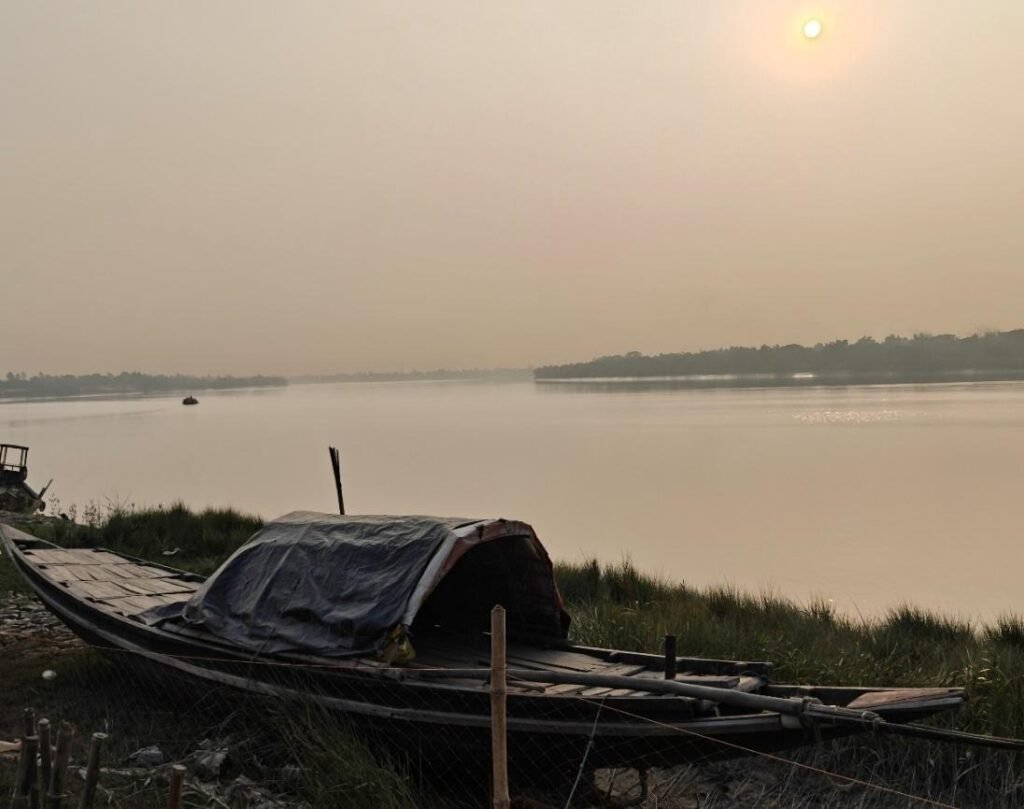
Throughout these days, a shared realisation emerged: the people of Kumirmari do not primarily frame their lives through the lens of catastrophe. For them, the pressing concern is not the abstraction of climate change but the immediacy of making daily life viable; accessing basic amenities, negotiating social relations, resolving minor conflicts that nonetheless carry life-altering consequences. What appears “trivial” from the outside is, in fact, structurally decisive. That is not the conclusion or end of this research. The common thread binding these three days is a sustained movement from the spectacular to the ordinary, from global crises to everyday negotiations, from theoretical perspectives to contextualising daily lived experiences. By zooming in we began to see the Sundarbans not as a uniformly vulnerable site, but as a space dense with dialectics, contradictions, and social intricacies. That said, this process also foregrounded our limitations as researchers. We arrive temporarily, ask questions selectively, translate lived pain into academic language, and eventually leave. Our access is partial, our interpretations mediated, and our presence shaped by privilege and mobility. The question then is not simply what can we document, but what escapes documentation altogether. What stories remain untold even after we leave? What does not translate into data, images, or archives? And yet, despite these limitations, or perhaps because of them, the field school quietly tethered me to Kumirmari. Like the boat that continues to carry people and stories across shifting waters, the work opens up the possibility of return: to Kumirmari and its neighbouring islands, where narratives remain fluid, unfinished, and insistently alive.
About the Author:
Shahrukh Khan is a doctoral scholar at the English and Foreign Languages University, Hyderabad, India. He has completed his M.Phil. in “The Metaphor of Home in Sea Fiction: A Critique of Yann Martel’s Life of Pi and Joseph O’Connor’s Star of the Sea” from Mahatma Gandhi Central University, India. He was awarded the Gold Medal in M.A. English from Aliah University, Kolkata. He has been published in the Cambridge Scholars Publishing, Taylor and Francis, and Lincom Press, Germany. His research interests include Blue Humanities, oceanic studies, and environmental humanities with a particular focus on South Asian literary and cultural contexts.
Shahrukh Khan
PhD Research Scholar
The English and Foreign Languages University, Hyderabad
shahrukhphdlit22@efluniversity.ac.in