
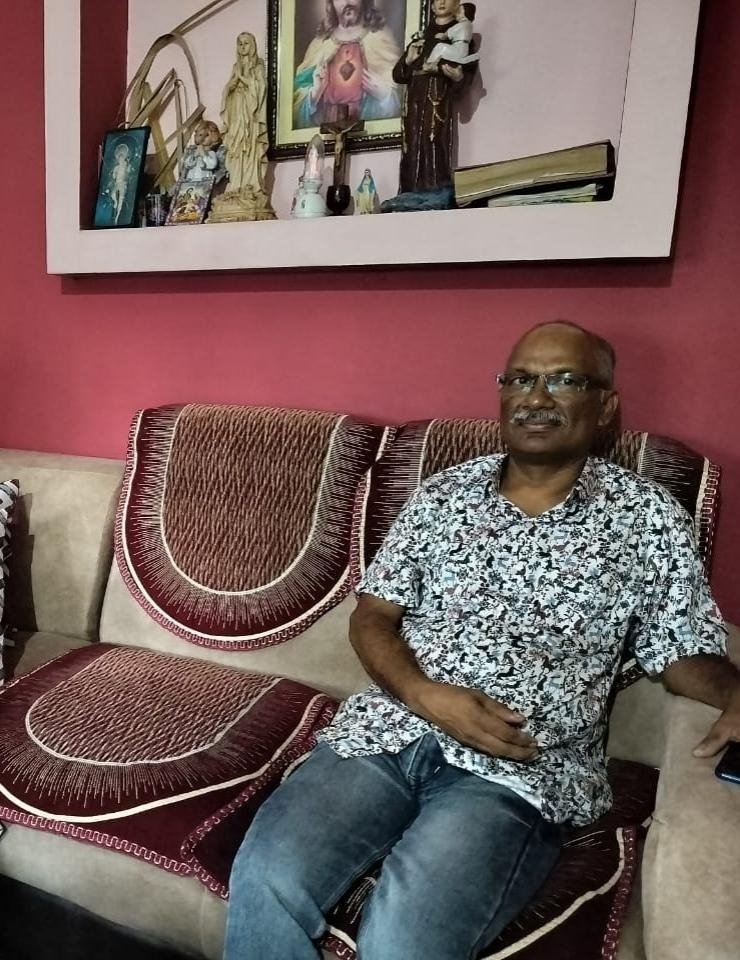
Caption
Johny Miranda talks about his life as a Paranki writer from Kochi as well as his interest in excavating lost traditions and oral narratives of his community, in an interview with Grace Mariam Raju.
Introduction to the author
Johny Miranda is a contemporary Malayalam author from Kochi. He belongs to the Indo-Portuguese creole community, known as the Parankis. His published oeuvre includes an anthology of short stories, Pushpa (2019), and novels such as Jeevichirikkunnavarkku Vendiyulla Oppees (2004), Puzhyude Pariyamum (2016), Nanja Mannadarukal (2019), and Athruptharaya Aathmakkal (2024). Additionally, he authored a novella titled Visudha Likhithangal (2001). Jeevichirikkunnavarkku Vendiyulla Oppees (2013) is Miranda’s most acclaimed work, translated into English as Requiem for the Living (2015) by Sajai Jose. It is the first novel in Malayalam that portrays the cultural world of the Luso-Indian community. Miranda’s fictional world depicts compelling stories from archipelagic Kochi. He engages with ideas such faith, community living, dying traditions, and linguistic registers that are only found in the Paranki community. Furthermore, Miranda has balanced writing fiction along with his job as an employee at the Kerala State Electricity Board (KSEB). Therefore, most of his characters belong to the working class group. He has now retired from the KSEB and lives in Kochi.
Interview
Grace Mariam Raju: How did you begin your writing journey? What inspired you to write fiction?
Johny Miranda: I began writing short stories at the age of sixteen. The “Kerala Times,” a Christian owned local newspaper, used to publish my short stories. The newspaper ceased its publication long ago, but during its time, it would provide opportunities to young people from the Christian community to publish articles, stories, and other pieces of writing. I used to regularly submit my short stories to them, and they would often publish my work. Then my work got a platform in the magazine Bhashaposhini, where the then editor C. Radhakrishnan introduced my short story in 1996, and he wrote that the story captures central Kerala’s coastal language, which also reflects the coastal communities’ cultural and linguistic registers. I penned the story using a dialect that is spoken by people in Ponjikkara, Moolampilly, and Mulavucad areas. Generally, all the backwater islands and coastal villages speak this dialect, but with slight variations in places such as Mattancherry, Vypin, Fort Kochi, and Eda Kochi. This experience inspired me to write about my place and culture as well as to pursue my passion for writing fiction. Following the publication of my story in Bhashaposhini, I received numerous letters from various parts of Kerala, expressing praise and gratitude for my efforts to introduce such a culturally rich community through fiction. After which, I published another story, “Pappanjiyude Chitram” (The Portrait of Pappanji). The Parankis refer to their grandparents as Pappanji and Mammanji. Our families and homes commonly use this term. However, it is very unfortunate to see that the Kochi Carnival has appropriated the figure of Pappanji as an old man, whose effigy is burnt during Christmas, symbolising some ancient ritual. The burning of Pappanji at the carnival deeply disturbs me. I tried to bring the Paranki culture to the mainstream, but the readership is very low in Kerala. However, I am grateful to Sajai Jose and Professor J. Devika for the English publication of Jeevichirkkunavarke Veendiyulla Oppes, after which some of my other books also received readership.
Grace Mariam Raju: Your fiction makes a significant contribution to the Malayalam literary world. The Luso-Indian community in Kerala has never been represented in literature or films before. But through your writings, especially with the English translation of your novel, opened the Creole world for people within Kerala and outside. Since the Luso-Indian community was integrated into the category of Anglo-Indians, your literary writings, therefore, rescued the Parankis from getting assimilated into the generic cultural portrayal of Anglo-Indians.
Johny Miranda: People with European ancestry commonly refer to themselves as ‘Anglo-Indians’. In this sense, Parankis are the descendants of Portuguese traders and soldiers who arrived in Kerala and Goa. Therefore, we have inherited their names. For instance, I am Miranda, and my wife is Perreira. The Portuguese have significantly contributed to the city by building schools, churches, and hospitals. As you might know, the empire stretched from Brazil to Malacca. All of that history is available, but now their traces are felt in the community. Our mixed heritage extends from Brazil to Malacca, where some of our ancestors arrived as skilled and semi-skilled labourers. Even our traditional clothing, the thuni and kavaya, bear a striking resemblance to the traditional attire of Southeast Asia. Charles Diaz’s book on Luso-Indians captures the community’s anthropological history. However, I didn’t have access to the community’s authentic history or lineage when I began writing. I was unaware of the documented history of Anglo-Indians and Luso-Indians. I had no idea that the term “Creole” even existed. The English translation of the novel introduced me to the academic world, revealing studies on mixed groups such as the Anglo-Indians. I have crafted my stories based on my personal experiences growing up as a Luso-Indian in Kochi, as well as the culture I was immersed in, without considering the academic potential of my work. Therefore, I have never consulted any archives or looked at the documented history of my community while writing my stories. Also, I have never studied my community from an anthropological perspective to write a story. Instead, I have written my stories from my memory as well as from stories about our people that I have heard while growing up or from other people in my community. My wife has shared numerous stories about her grandparents, and it is those stories that form the premise of my writing. You could say stories are my archives.
Grace Mariam Raju: Despite your claims about the word creole and its academic manifestations, your engagement with the community’s cultural world and human predicaments is fascinating. Your stories encapsulate the essence of Luso-Indians living in the remote islands of Kochi. Also, your depiction reflects an honest and authentic representation of the community.
Johny Miranda: I try to focus on the everyday and ordinary lives of people from my community. This was also deliberate because the underlying conditions of my community are not very rich and dynamic in the sense that most people live in poor conditions. They also have a history of labour, with the majority having been brought in as labourers by the colonisers. After colonialism, they continued working as fishmongers, carpenters, and other semiskilled labourers. This community is marginalized and educationally disadvantaged, yet their mixed heritage has led to the practice of interesting rituals and traditions, influenced by Portuguese and local cultures. So quintessential things that otherwise represent the Anglo-Indian community remain unknown to most people in our community. For instance, most members of our community do not speak English at all. But the existence of our community has never been discussed or represented, even in the passing of popular culture, such as films or major literary fiction. Even the coast and backwater islands remain under-represented in Malayalam fiction and films. Ponjikkara Raphy, a prominent writer from Kochi, remains largely unknown to the mainstream population in Kerala. My stories, thus, are not written deliberately to fill a vacuum, but I wrote them only for my passion for reading and writing. Also, I am not educated enough to academically mark the erasures and silences of my community. I penned my stories from an unaware position, believing that my experiences should serve as the premise for my creative endeavours. Therefore, I did not write my novels for any academic merit, but they naturally found their place in my cultural world.
Grace Mariam Raju: Kerala’s socio-cultural milieu has a rich history of migration and cross-cultural influence. In this sense, Kerala’s culture is not as pure and authentic as it presents itself to be. In this regard, the Parankis also have a mixed heritage which should be appreciated and valued, but there seems to be some kind of divide between other communities such as the Syrian Christians or dominant communities towards Luso-Indians. How do you then situate the Luso-Indians within the broader social, cultural, and political context of Kerala?
Johny Miranda: In terms of the homogenous identity that Malayalee identity encompasses, my community may seem to be different. Therefore, many members of the Paranki community, particularly the common people, exhibit very little political mobilisation or cultural consciousness. Unlike other communities that are more stratified and politically organised, they may come across as careless, alcoholic individuals who participate in extravagant celebrations. This phenomenon also stems from the long history of social and cultural marginalisation of the Luso-Indians and the coastal communities in general. Also, Iberian Catholicism is a prevalent influence in Kochi and within the community itself. In that context, the community has colonial traces, which also deepens the divide between other communities and the Luso Indians in Kerala. Therefore, our narrative about Portuguese colonialism is unique, as we have inadvertently derived our culture from the Portuguese. This adherence to Portuguese culture further sets us apart from other communities. However, our language and culture have been lost due to the community’s assimilation practices. Few linguistic registers remain, but our community has never consciously attempted to consolidate or stratify cultural elements for future generations, leading to the eventual loss of cultural markers among the younger generation.
Grace Mariam Raju: Do you believe that cultural stratification and consolidation are necessary for the community to maintain its cultural markers for the future generation?
Johny Miranda: People like you, who wish to study and analyse the community may feel the need for such cultural stratification and consolidation. But for ordinary people like us, we understand that to maintain culture and traditions requires capital resources, which can be challenging for many members of our community. To sustain and preserve cultural markers is also a matter of convenience, but some of us are making every effort to preserve whatever little we can. I realise that now it has become impossible to see a Paranki woman dressed in thuni and kavaya. This is because the younger generations seem to have changed over time, and they stopped wearing the traditional attire. It does not attest to the fact that we are embarrassed by our ethnicity or culture, but I also realise that there is a lack of community pride due to our mixed ancestry. Our rich genealogy of Portuguese, Malaccan, and Indian descent has not yielded any tangible outcomes. Furthermore, the mainstream cultural narrative conceptualises Malayalee identity as a homogenous entity with a singular origin story or shared cultural markers and not as a heterogenous entity. Further, people themselves have conveniently moved away from histories of caste and gender, which were those of cruelty and brutality, but the stigma continues to haunt people at the margins. So, in that sense, not many communities can take part in cultural or community pride if we look at the history. Therefore, brutalities of the past are something that people have conveniently forgotten and have become stratified into homogenous cultural and political identities, which has led to erasures.
Grace Mariam Raju: Your novels serve as a repository to understand the cultural world of the community, documenting the recipes, prayers, attire, songs, and mannerisms of the Parankis. However, are you saying that the younger generation has no interest in retaining the Creole past?
Johny Miranda: Lower caste communities such as the Pulayas take no pride in the history of pollution and untouchability. Similarly, in our community, people do not want to remember the Creole past. Assimilation into popular culture is a preferred choice, as it offers convenience and reduces alienation. Now that the times have changed, we find ourselves located, rooted, and belonging here. However, it does not mean we endure identity crises all the time! Common people don’t have the time to think about the glories of the past nor to identify any kind of internal crises, but sometimes, some experiences get registered in our minds. Thus, resistance would mean overcoming daily challenges, earning a living, and prioritising family. Therefore, most of the people are far removed from any form of ideological stratification. In this context, my stories come from such a space where I have tried to preserve whatever is left when most people in the community are trying to move away from their cultural history. For instance, when a Paranki man marries a Paranki woman, then they remain Paranki, but since people are not very adherent to marrying within the community, they also prefer to marry outside the community. As a result, they will assimilate into the community that they are marrying because we never had strict rules for marriage and kinship like other upper-caste communities. Likewise, our culture is very different from many other communities in Kerala. For instance, we have more egalitarian marriage rituals, and even in marriage, women and men have equal roles. Ours is not a male dominant community, and our women are more efficient than men, sometimes surpassing the men in their families. We also address each other by our first names, and there is no power division between husband and wife, unlike in other communities where the husband tends to be more controlling. In light of these gender dynamics, I would prefer that my daughters marry Paranki men. Otherwise, our community is very open and accommodating to differences, and more importantly, men value the empowerment and efficiency of women. My female characters are all inspired by women with whom I have had the opportunity to interact, observe, and share my life during my early years. In a way, my writings function as a repository of Paranki culture and life, which I have unconsciously documented.
© Grace Mariam Raju