
Neil van der Linden
Music and rituals originating from Africa south of the Sahara are present all over North-Africa, South-West and South Asia. In Morocco, we have the Gnaoua, as well as some specific Amazigh rituals like Ahouache and Zar. Zar is a spiritual healing rite, existing in Sudan, Egypt, the Arab Peninsula, Iran’s South-Coast and in the Persian Gulf islands. Other examples of music and rituals originating from Africa, south of the Sahara, are the Liwa around the Arab peninsula, and the Sheedi, Siddi or Habshi culture in Pakistan and India. Both are close to Zar. There are also manifestations of African culture in Sri Lanka, the Maldives, Seychelles, in Western Indonesia and in Turkey through the Ottoman Empire. The distribution is related to former trade routes, including slavery. Many people of sub-Saharan African origin are descendants of enslaved people and the trade was carried out across the Sahara and the Indian Ocean by Portuguese, Zanzibari and Omani traders.
The book named Mecca, published in 1889 by the renowned Dutch Orientalist Christiaan Snouck Hurgronje, contains an intriguing lithograph. In German, it is titled Negersklaven mit dem tambura-orchester, in Dutch, Tumbura-orkest op de binnenplaats van het Nederlandse Consulaat in Jeddah, and in English, A Tambura Orchestra in the Courtyard of the Dutch Consulate in Jeddah. The tambura or tumbura or semsimiya is a large standing lyre-like instrument, derived from African music culture. Apart from several kinds of drums, there is another typical instrument in sight, the manjur. It is a belt decorated with goat hooves that make a rustling sound when the one who wears it moves.
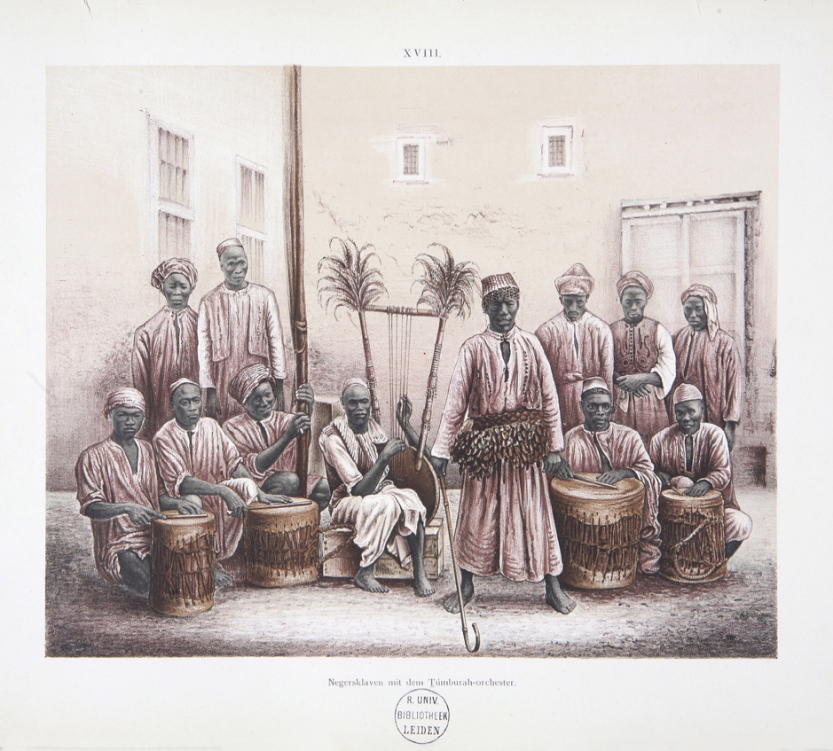
Lithograph showing African enslaved musicians at the Dutch consulate in Jeddah from around 1890, commissioned by Dutch Orientalist Christiaan Snouck Hurgronje after photographs he took.

Painting showing a black dancer with an African harp, the tambura or semsimya, known as nanga in India, on a 17th century illustration from the Deccan, India, now in the Cleveland Museum.
In many regions, such rituals have been adopted by the contemporary performing arts.
Zar is one of the still most recognizable rituals of sub-Saharan East-African origin, which, by voluntary migration or forced migration (slavery), spread over a wide area. It can be found in Egypt, Sudan, Kuwait and Iran. It probably existed in many more countries around the Indian Ocean but it has disappeared in many places for several reasons. One of them is that it was considered heretical. Other reasons are that it evolved into different manifestations, merged with other rituals, or just became obsolete due to the effects of time, fashion, mundialization, etc. This can happen to any of the rituals mentioned in this paper.
Today we find Zar mostly in Egypt and Sudan, and also in Iran – along its coastal regions, in Abadan and Bandar Abbas and on the island of Qeshm.
Iran
In recent years, there have been several stagings using elements of Zar in Iran. In ‘Dingomaro’, a show from Abadan which was staged at the Teheran Fajr theatre festival of 2005, elements of Zar can be found. At that time, within the framework of theatre, women could sing during a performance for a mixed audience. But in 2006, due to restrictions, only men could sing at the Fajr festival. Four years later, a mixed group could perform again at the Fajr theatre festival. In Only the First Dog Knows Why it is Barking by the Titowak theatre group from Bandar Abbas, Zar elements are blended with Shakespeare’s Macbeth.
Dingomaro is a Swahili name for one of the spirits that came with Zar culture from Africa. During many Zar rituals in the region, the name of Dingomaro is being addressed.
Dingomaro performance at the Tehran City theatre during the Fajr theatre festival in 2005.
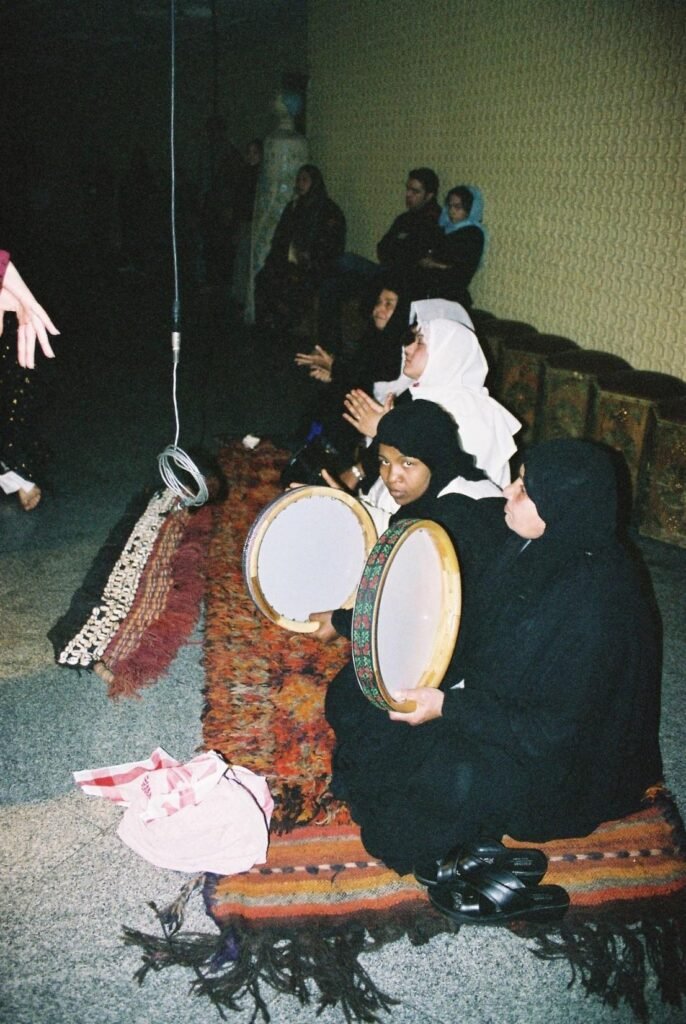
Zar musicians from Bandar Abbas during the Teheran Fajr music festival in 2006.
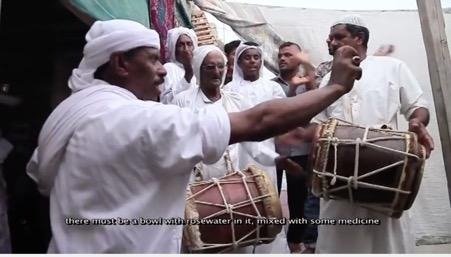
Screenshot from a documentary on Zar and other African cultures in Iran.
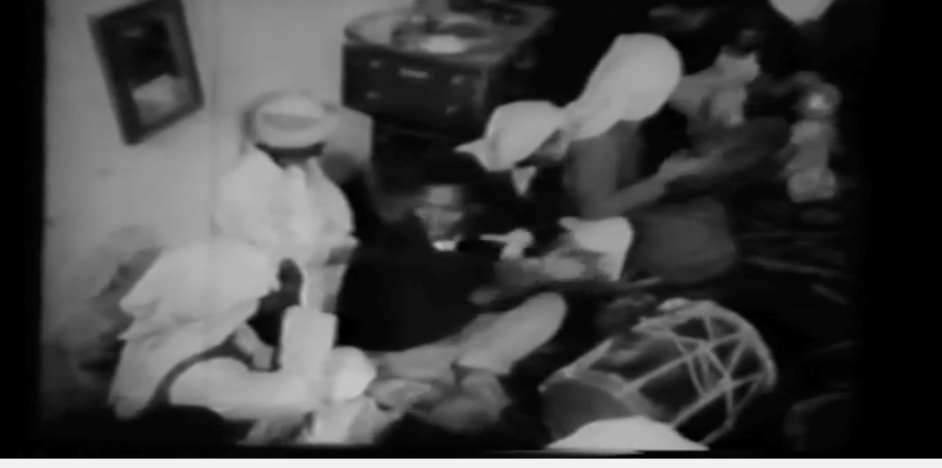
Screenshot from Iranian documentary maker Nasser Tahgvei’s Wind of
Genie based on Zar in Bandar Abbas.
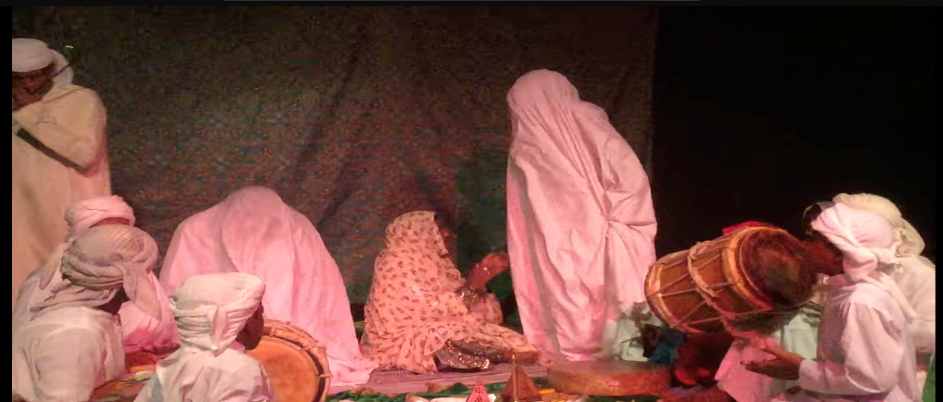
Zar from the island of Qeshm in the Persian Gulf in 2015
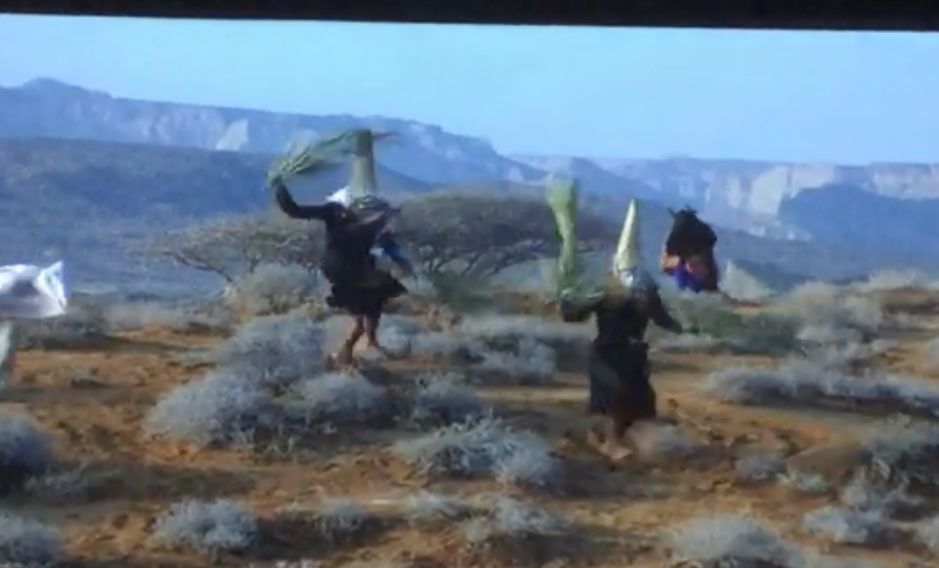
Fishermen’s Norouz combined with Zar on Qeshm island, Iran, 2016.
On the South coast of Iran, there is a typical local music centred around the ney-anban, or neyhambune, which is a Persian bagpipe that can mostly be found in Bushehr. A similar instrument is found across the Persian Gulf in Kuwait, Saudi-Arabia, Bahrain, Qatar, the United Arab Emirates and Oman. It has a variety of names across the region, including habban and jirba. In most places it is gradually disappearing but in Bushehr it is still popular.
Neyan-ban ensemble from Bushehr, Iran.
The bagpipe is often played by an ‘Indo-Aryan’ performer while the percussionists often are of Afro-Iranian origin.
Note by the author: This phenomenon, which certainly has racial if not racist aspects, is found elsewhere as well. I noticed that in a group from Asir, Saudi-Arabia, which I had invited to perform during a festival of Gulf states music in Abu Dhabi, the percussionists were of Afro-Saudi descendance. Other than during the performances they never mixed with the other members of the group. They stayed together and always walked behind the rest of the ensemble.”
Neyan-ban ensemble performing at the Kerman folklore music festival, Iran.
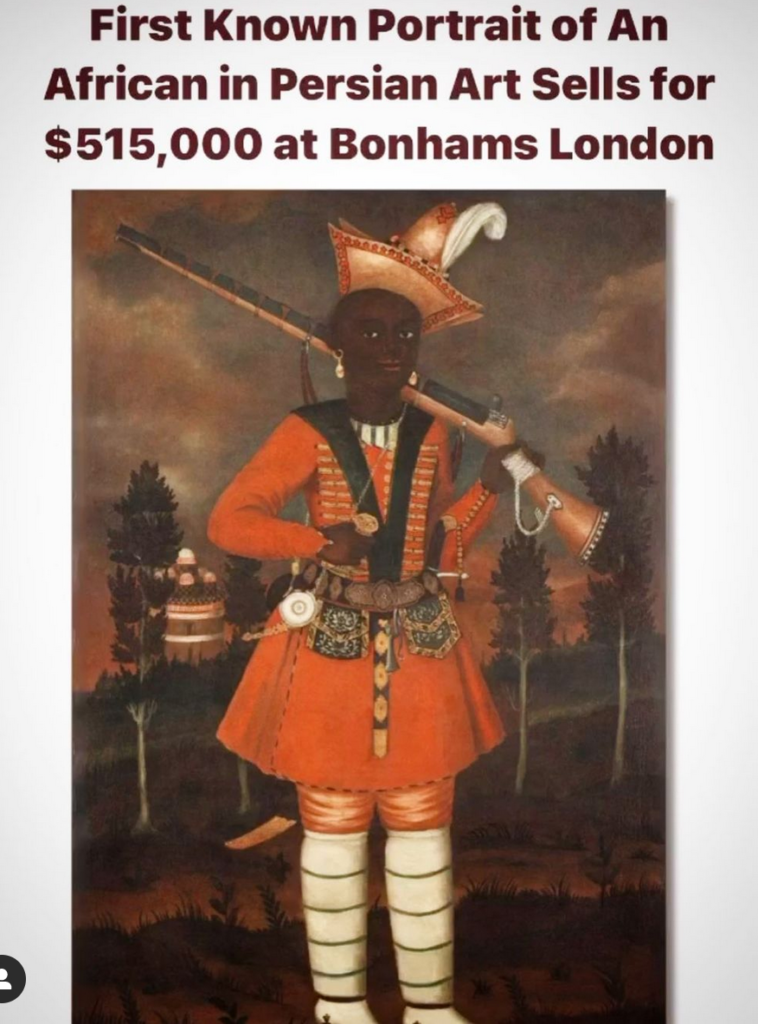
Painting from Iran.
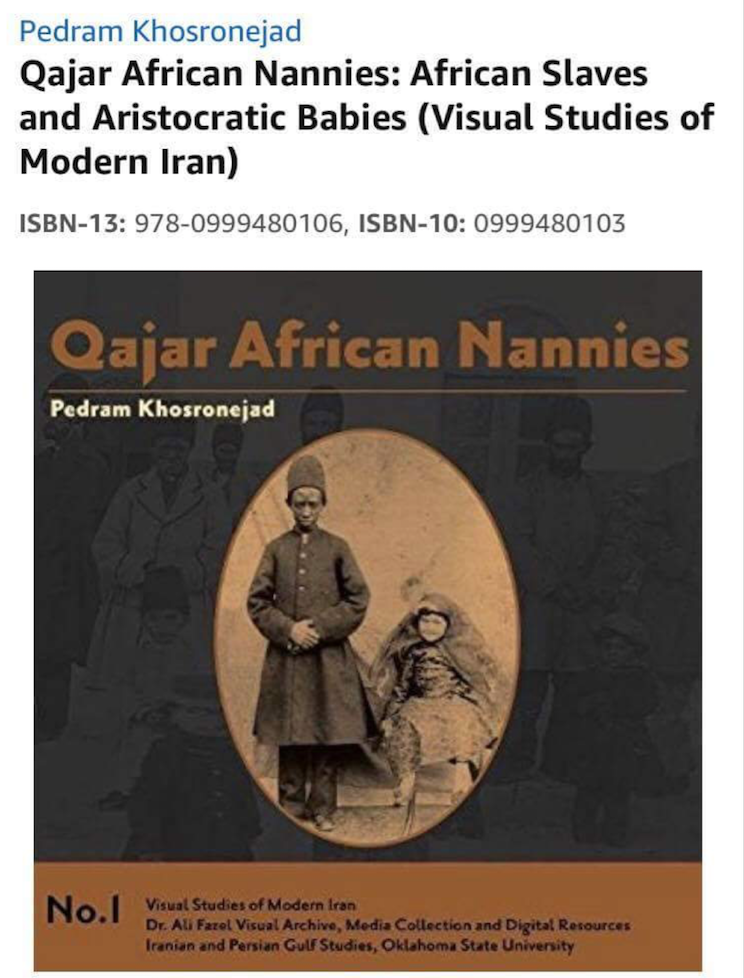
Book on African nannies during Iran’s Qajar era. Enslaved persons and their descendants were often involved in in-house matters. They could even reach high social positions; compare the remarks about Afro-Indians in military hierarchy elsewhere in this paper.
Egypt and Sudan
I included Egypt and Sudan in this paper as a part of the forced or voluntary migration of peoples from the sub-Saharan branch of this region as well, maybe partly by land but also by sea. The Red Sea is a branch of the Indian Ocean. There was a parallel evolution comparable to what happened around other parts of the Indian Ocean.
An early contemporary adaptation of Zar was The Expression of Zar or Wire Recorder Piece by Egyptian avant-garde composer Halim El Dabh, who recently passed away. It is an electroacoustic collage on wire tape with visuals, presented at an art gallery in Cairo in 1944.
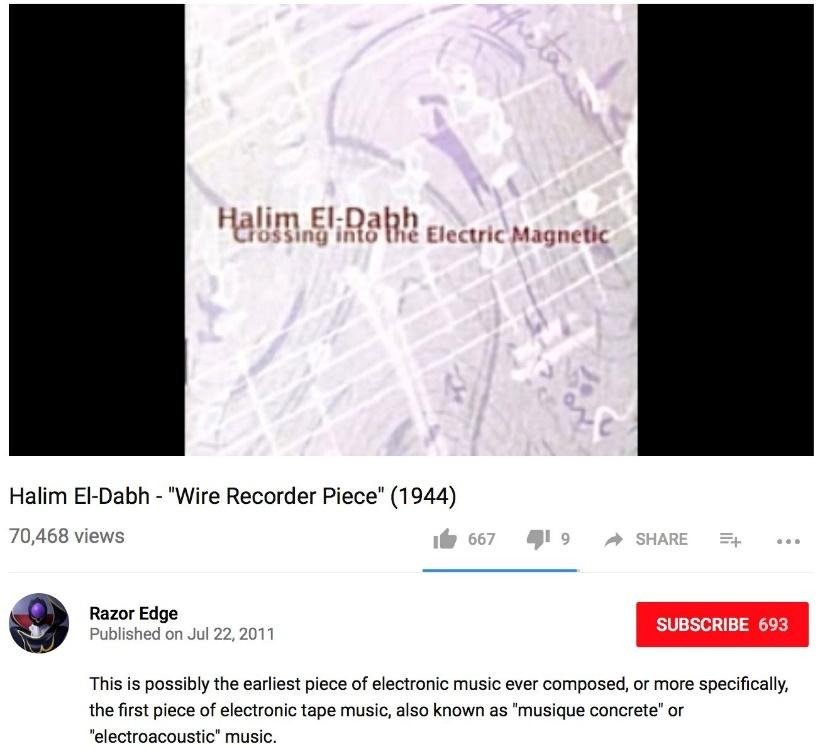
Screenshot of Halim el-Dabh’s Wire Record Piece otherwise known as The Expression of Zar on YouTube.
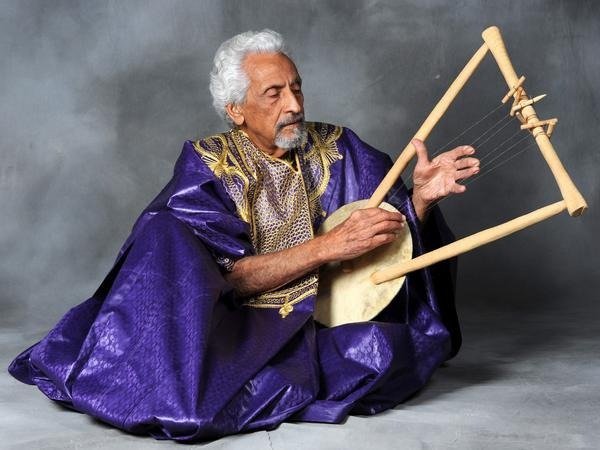
Halim el Dabh with a semsimiya.
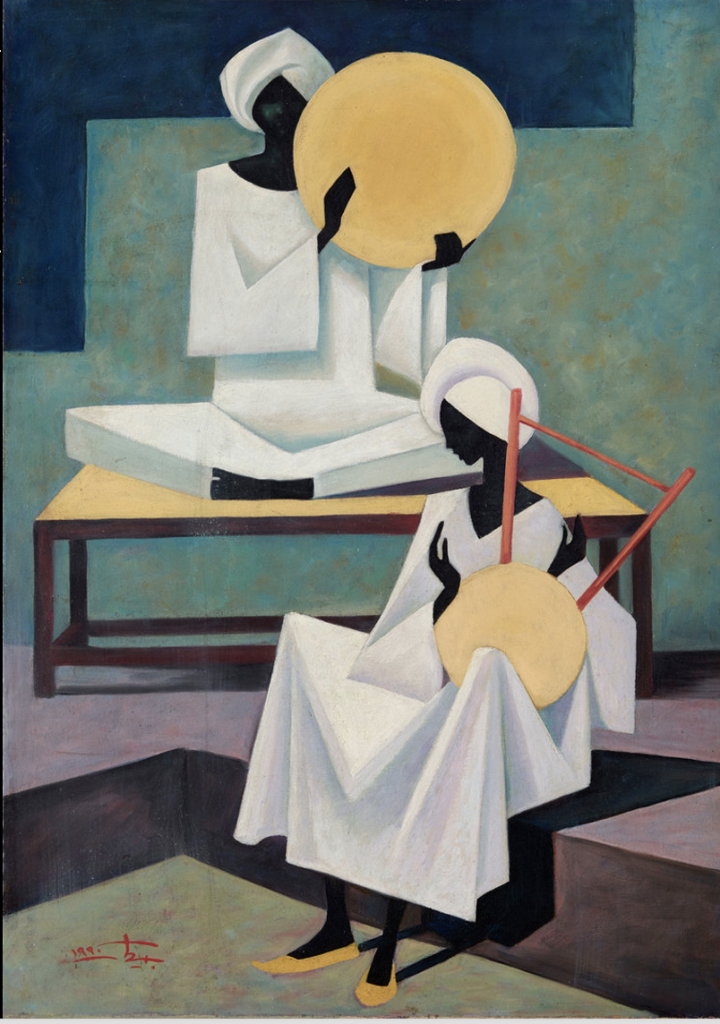
Two Black musicians with a lyre and a drum in a painting by the Egyptian 1950s modernist painter Sayed Sadeldin.
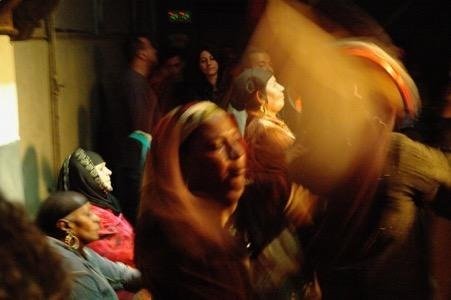
Zar in a concert-format performance by the Mazaher ensemble, Cairo 2006.
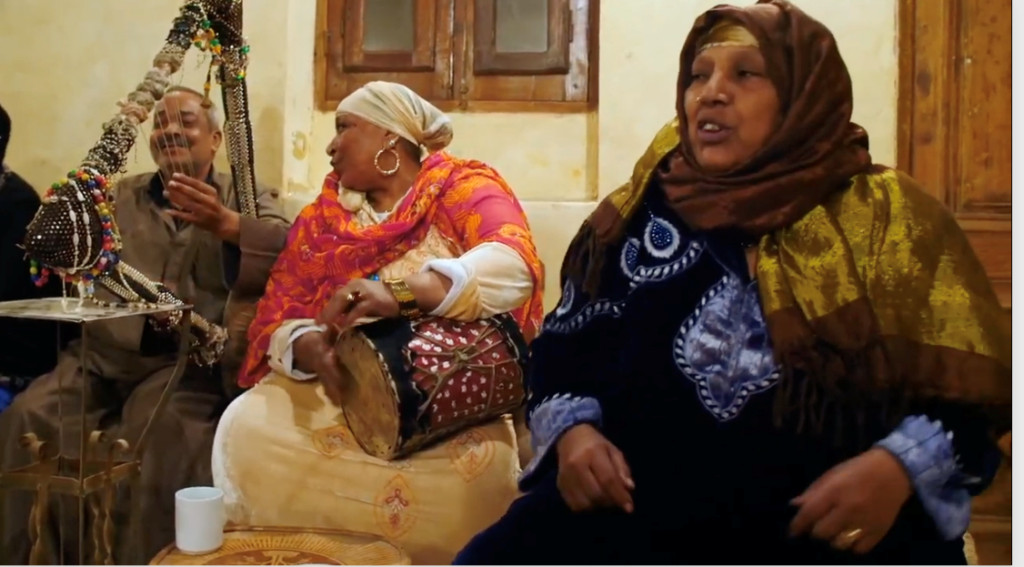
Screenshot from a videoclip of the Mazaher Ensemble, Cairo, Egypt.
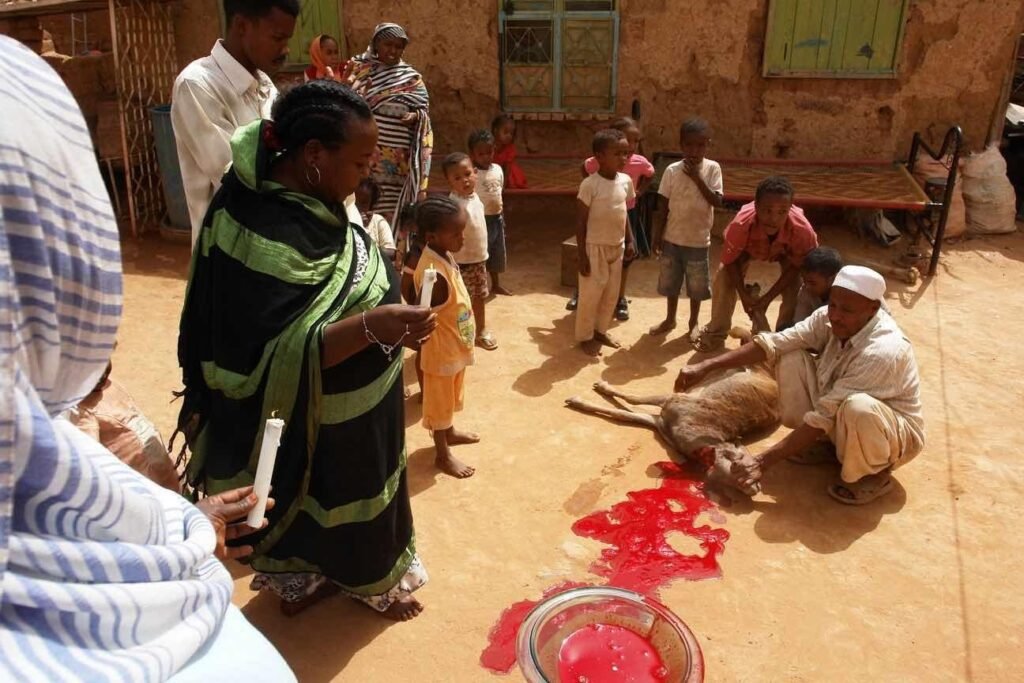
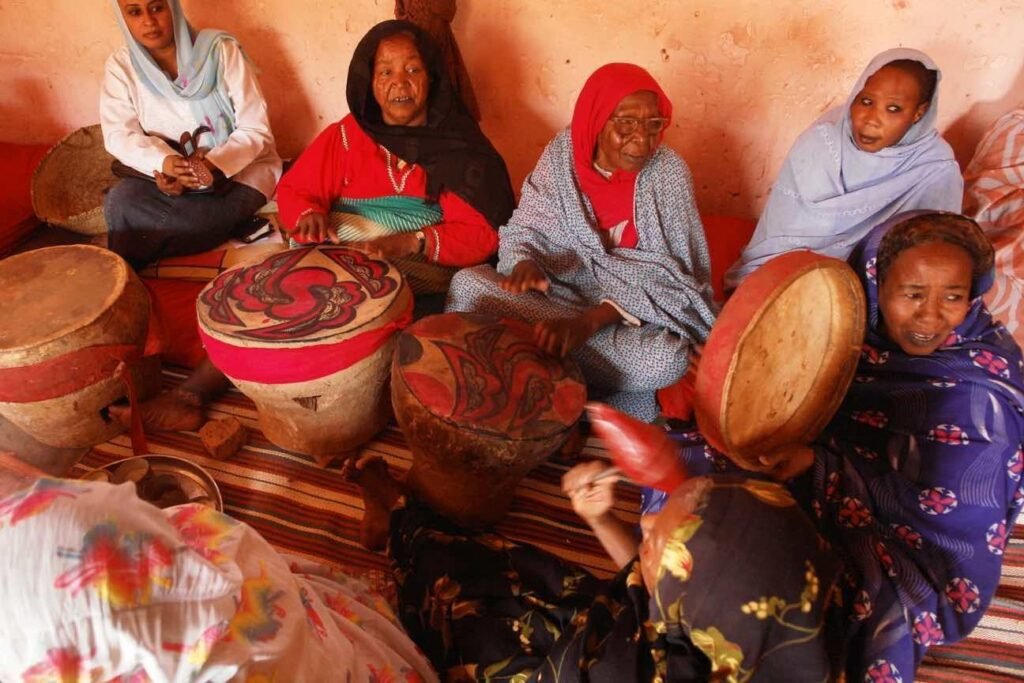
Scenes from a Zar ritual in Khartoum, Sudan.
Morocco
As sub-Saharan forced and voluntary migration easily reached the West side of North-Africa as well, it is interesting to compare its manifestations in the framework of this paper.
The Gnaoua festival of Essaouira in Morocco presents original music from Gnaoua rituals and combines it with musical styles from Africa or from Afro-American culture, like reggae (the Wailers) and jazz (Joe Zawinul, Omar Sosa).
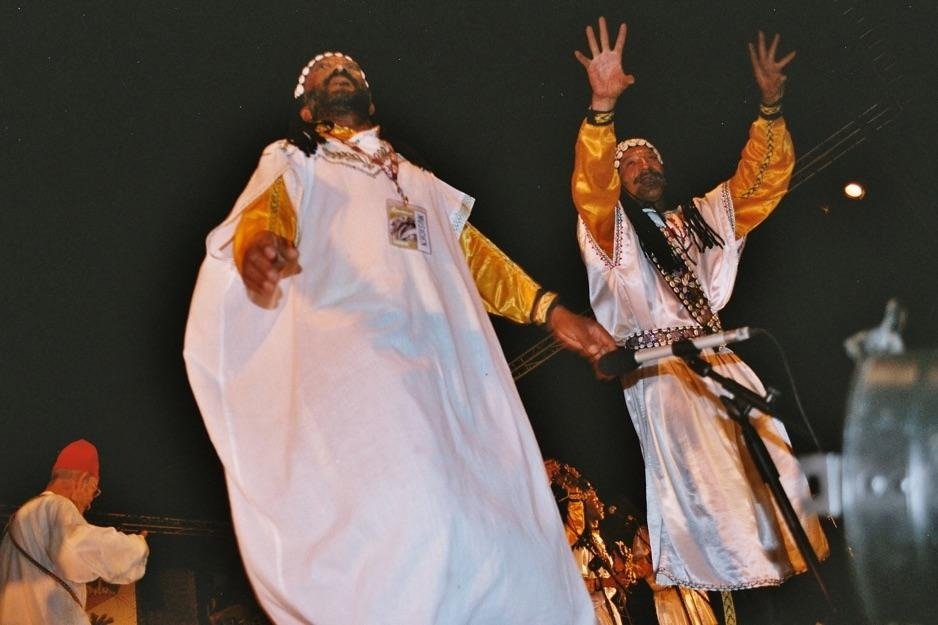
Gnaoua ensemble of Hamid Al Kasri at the Gnaoua Festival of Essaouira 2005.
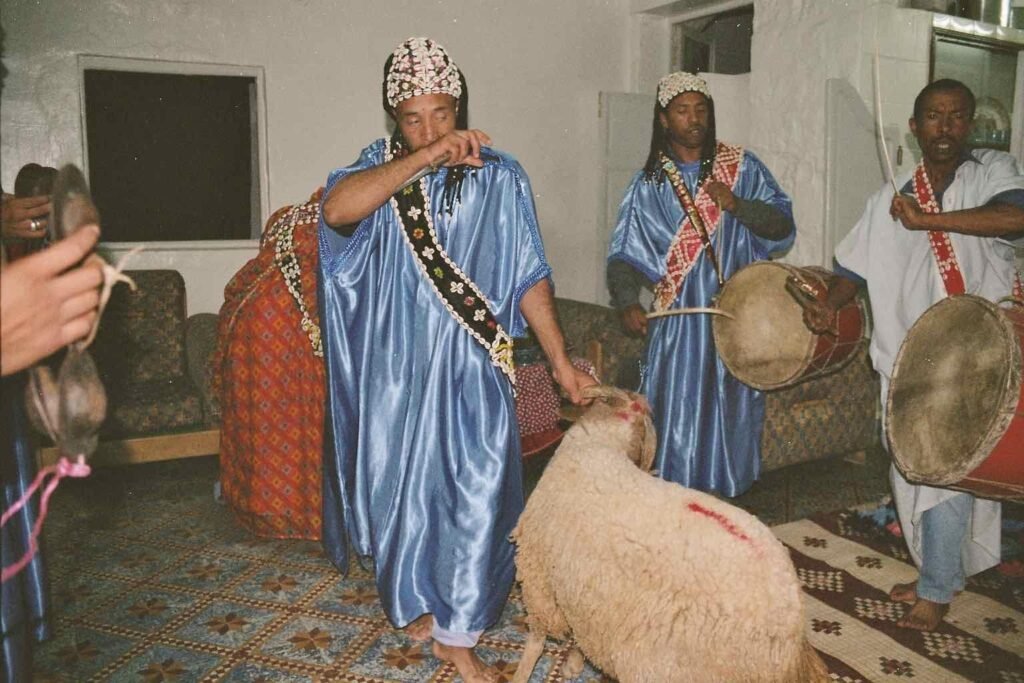
Authentic Gnaoua healing ritual at a home in Meknes.
Throughout Morocco, with its longstanding trade routes crossing the Sahara, and with its sea routes to the Southern parts of Africa along the coast, African cultures mixed in a natural way. African cultures mixed notably with the Amazigh cultures and can be seen most clearly in the Ahouache rites, in Daqqa and, to a lesser extent, in Ahidous. They are authentic Amazigh music and dance performance genres and are practiced across the High and the Minor Atlas and in the valleys between these mountain ranges. Amazigh cultures, otherwise known as Berber culture, was a natural bridge between the North and sub-Saharan cultures. In fact, it is important to realise that Amazigh cultures were a continuous entity, stretching from the Moroccan coasts through Algeria, Tunisia and Libya into Egypt and Nubian Sudan. In the Egyptian oasis of Siwa, a form of the Amazigh language still exists, and some of the pharaonic dynasties, originating from what is now Sudan, had Amazigh roots. Amazigh culture throughout North-Africa has functioned as a sort of aquifer transporting North and sub-Saharan cultures across the Sahara.
Gnaoua group from Tinehir, Morocco, with Amazigh Ahidous influences.
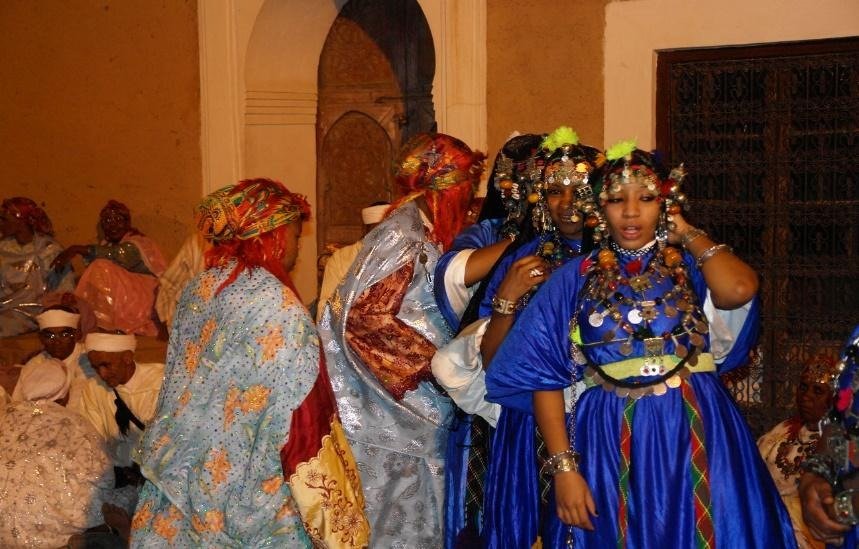
Ahouache ensemble performing in Ouarzazate, Morocco.
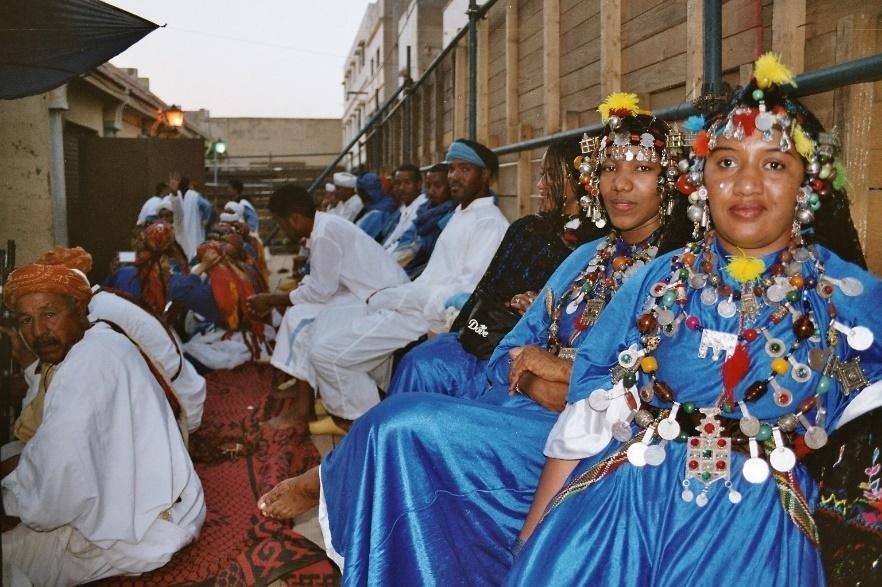
Ahouache ensemble from Tissint, Morocco.
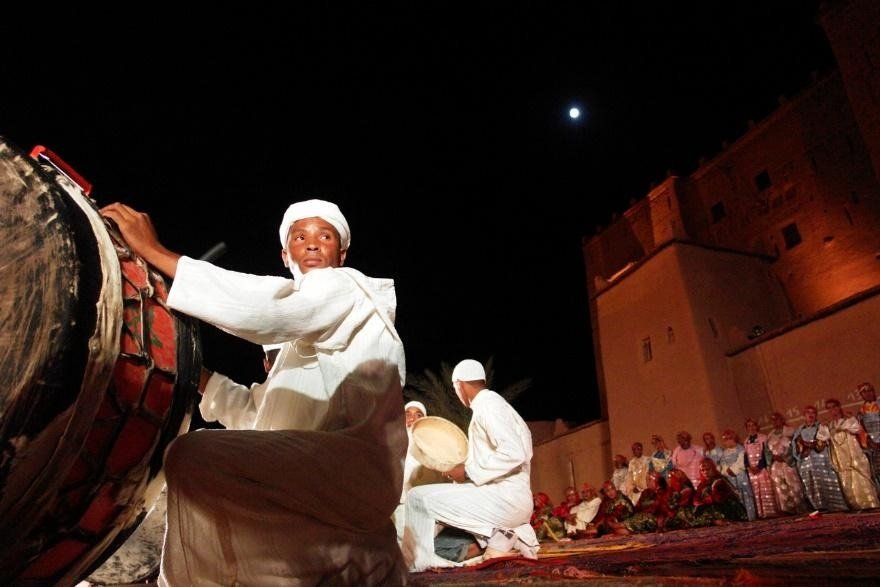
Ahouache performance, Ouarzazate, Morocco.
Ahouache from Zagora, in the Minor Atlas region of Morocco.
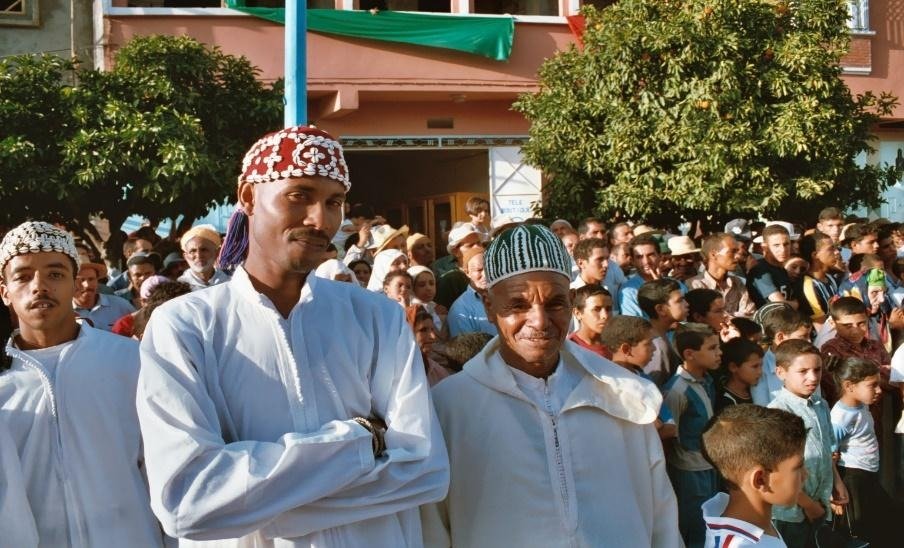
Ahouache and Daqqa parade in Demnate, Morocco.
The Gulf States
The generally considered low-class positionality of black communities in the diaspora could also be beneficial in a way. For instance, on the Arab Peninsula a ‘middle-class’ family would not easily let their sons, let alone their daughters, seek a career in singing. Yet, especially at segregated wedding parties, female singers were in demand. Descendants from the lowest classes like the Afro-Arab communities could fill the gap. The most famous was the Kuwaiti star, singer Aisha al Marta, who was black and blind. Many of her music arrangements are quite close to authentic African percussion styles. Ouda Al-Muhanna was another top iconic singer from Kuwait.
There were also popular female singers from Bahrain and Itab from Saudi Arabia. Clearly, Afro-Arab women were not very restricted to take up a career on stage.
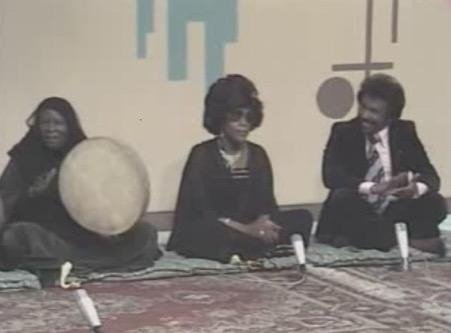
Blind Kuwaiti star singer Aisha Al Martha.
Saudi star, singer Itab.
The Arab Peninsula (Oman, Yemen, Bahrain, the Emirates) is rich in Afro-Arab subcultures. Many of the black communities of Saudi-Arabia are poor but at the same time, the governmental control on them is more relaxed than on the indigenous urban Arab communities. For instance, in Jezan in the far South-West of Saudi-Arabia (next to Yemen and opposite Eritrea), exciting Afro-Arab music styles can be heard.
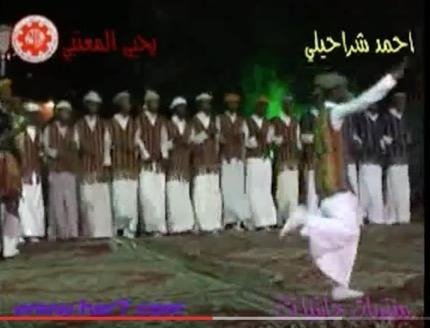
Village performance from Jezan in South-West Saudi-Arabia, next to Yemen
Liwa is a popular ritual music in the Arabic Gulf countries. It is an equivalent of Zar but less heavily laden.
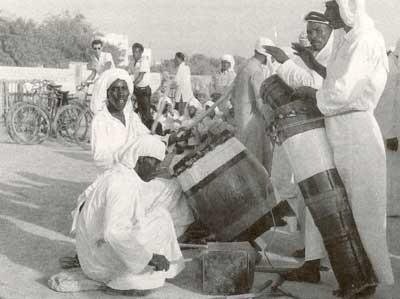
Liwa performers in Bahrain.
The pearl fishers of the smaller Gulf states were often enslaved people of African descent. Their musicians, who joined the pearl harvesting journeys, were the most highly paid on board. They were essential in keeping the divers’ spirits up.
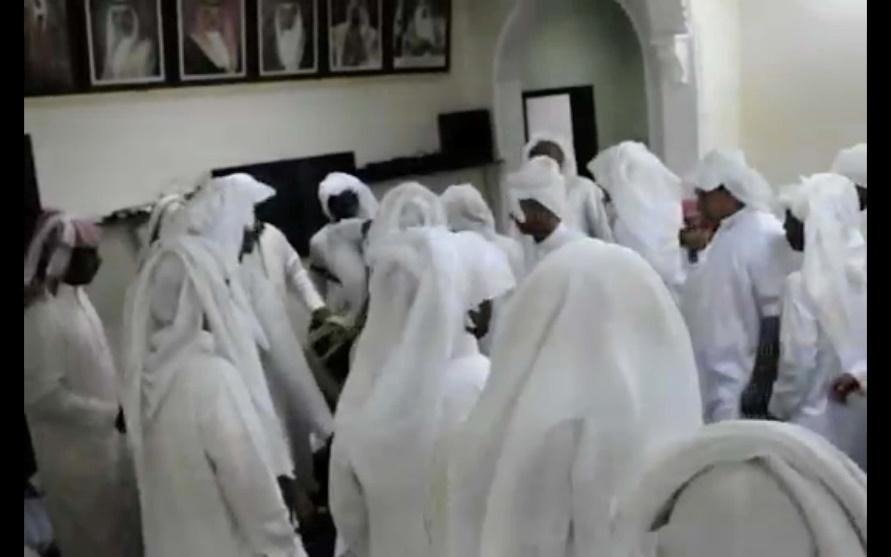
The Ghalali pearl-fisher music band from Bahrain at a home in Manama.
Egyptian visual artist Wael Shawky recently created a large theatrical installation based on the French epic La Chanson de Roland about wars between the Frankish Christians and the Spanish Muslims. It was translated into classical Arabic and was sung and acted by the Ghalali pearl-fisher music ensemble from Bahrain.
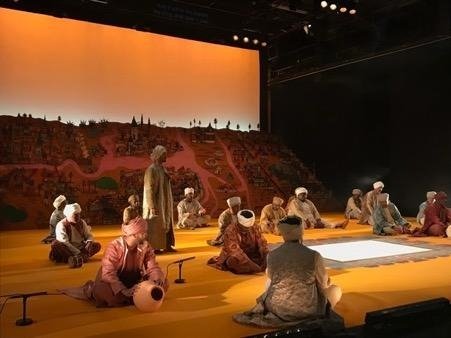
Wael Shawky’s theatrical installation La Chanson de Roland, sung and acted by the Ghalali ensemble, Afro-Arab pearlfisher musicians from Bahrain.
In 2015, the Saudi-based Aramco magazine (published on behalf of the national oil company) noted in an article how popular many of these genres continue to be in the Gulf. Despite urbanisation and gentrification, and although direct references to African roots seem to be avoided, several of the genres keep being popular. If you take a taxi in Doha, capital of Qatar, and Arab music is on the driver’s radio, the station could very well be 99.0, Sawt al-Khaleej, one of the most popular and powerful radio and digital streaming broadcast networks in the region. Based in Doha, its name translates to “Voice of the Gulf”, a fitting name for a network that seeks to appeal to a broad, Arabic-speaking audience with pan-Arab popular music that you can hear up and down the eastern coast of the Arabian Peninsula, from Kuwait to Oman.
Illustration from the article in the Aramco magazine.
Screenshot from a sixties or early seventies TV performance of a popular song by Rashid Al Mennaie and the Enad Ensemble from Qatar. Note the tambura halfway on the left and the manjur on the right. This is in common with the Nuban ensemble from the Emirates and with the Mazaher group from Egypt.
The brilliant Saudi video and music producer Majed Alesa produced some magnificent clips with music and performers from Saudi-Arabia’s Afro-Arab communities.
Still from Majed Alesa’s clip of the song Halik
Still from Majed Alesa’s clip for the song Lehe
Recently, the young Saudi director Faiza Ambah organised a community project in the poorer neighbourhoods of Jeddah, named “My vibe”, ‘Camera in your neighbourhood’, in which she involved young members of the community in a theatre and singing performance. All of the young participants were from the Afro-Saudi communities.
Still from Faizah Ambah’s “My vibe”, ‘Camera in your neighbourhood’.
Faizah Ambah also directed the wonderful movie Nour Shams about a single mother and her son from the Afro-Saudi community. The mother is a taxi driver and her son is studying but wants to go to France to learn deejaying, to the dismay of his mother (Spoiler: it all ends well, in a very nice way).
Still from Faizah Ambah’s movie Nour Shams
Front cover of Toufic Kerbage’s study of pearl fisher music of Qatar.
The Nuban ensemble from the UAE, which is based between Dubai and Sharjah, continues using local Afro-Arabic traditions.
Fan al Tanbura, by the Nuban ensemble from Sharjah/Dubai, playing Afro-Arabic music at the Abu Dhabi Book Fair, 2013. Notice the instruments that are similar to the instruments on the Snouck Hurgronje lithograph and that are also used in some Zar practices in Egypt.
Iraq
Iraq also has significant Afro-Arabic community. In fact, Basra was a centre of slavery. The Zanj Rebellion which took place from 869 to 883 was a major revolt against the Abbasid Caliphate. Begun near the city of present-day Basra, in southern Iraq and led by Ali ibn Muhammad, the insurrection involved enslaved Bantu-speaking people (Zanj). They were captured from the coast of Southeast Africa and transported to the Middle East, principally to drain the region’s salt marshes. The insurrection grew to involve both enslaved and freemen; Southeastern Africans and Arabs as well from several regions of the Caliphate. Tens of thousands of lives were lost before the insurrection was finally defeated.
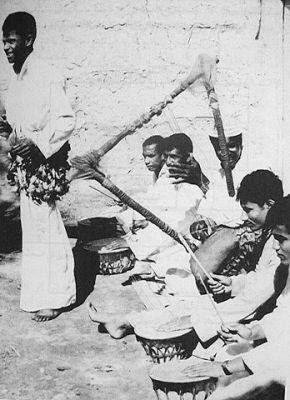
Noban musicians from Basra. Notice again the tambura and the manjur, the goat hooves belt.
The Subcontinent
India and Pakistan still have quite large communities of African descent, referred to as sheedi, siddi and seedi or habshi. Transliterated spellings may vary but both words are derived from the Arabic – respectively Said (overlord) and Habush, the Arabic word for Abyssinia. Researchers Beheroze Shroff, Amy Catlin-Jairazbhoy and the late Nazir Ali Jairazbhoy have been carrying out research in India, notably among black Sufi communities in Gujarat. For instance in the documentary The Sidi Malunga Project. Along with local expert Wasim Jamadar they visited African communities. They found the tanbura of East Africa under the name nanga. See also the aforementioned 17th century painting from the Deccan. But the instruments Catlin-Jairazbhoy and Jairazbhoy found did not have strings anymore and were not being played anymore. They were just being used as decoration in Sufi shrines.
Malunga, left, and nanga, on the right, in a Sufi shrine in Gujarat, as documented by Amy Catlin-Jairazbhoy and Nazir Ali Jairazbhoy
Wasim Jamadar performing on a restored nanga.
Recently their friend and colleague, musicologist Wasim Jamadar, himself of Afro-Indian background, has started to practice performing on the nanga in order to revive it. Another instrument of interest is the malunga, a sort of one-stringed-harp, which bears similarity to the berimbau. The berimbau is a single-string percussion instrument which is now popular in Brazil and originates from Africa as well. One can easily imagine a common ancestor of these instruments being transported from Africa in both directions: across the Atlantic and across the Indian Ocean.
Slavery practices did not go unquestioned. If we take the Portuguese colony of Goa for example, quite a few Europeans and North Americans of European ancestry in the colony protested and fought tirelessly to end slavery. Quite a few even had their lives ruined or lost for opposing slavery. By contrast, no evidence has surfaced thus far of indigenous Goans complaining or protesting against slavery, or fighting for its abolition. Available evidence suggests that in the 16th and 17th centuries, when slave trade was booming in the city of Goa, Goans who bought and sold slaves viewed their behaviour as legitimate and morally justified. At times, Goans successfully fought for other things; such as laws or behaviours they viewed as abusive but not against slavery. Unless future research proves otherwise, this silence strongly suggests that those days, slavery in the city of Goa was “normal.” Buying slaves was the cultural norm, the custom of the land.
As the researcher Patricia Souza de Faria noted, the dichotomy between “being free” and “being enslaved” might be too simplistic to describe the multiple forms of mutual dependency and slavery in India and other South Asian societies. She cites the following definition of slavery given by the researcher Richard Eaton: “the condition of uprooted outsiders, impoverished insiders – or the descendants of either – serving persons or institutions on which they are wholly dependent.” According to this definition, the Indian caste system would be an example of “immobile slavery”. It is likely that the “normalisation” of slavery that took place in Goa was facilitated by the Goan society having been primed by its local system of mutual dependency, the caste system. A system that Christianisation could not completely erase. The “normalisation” of slavery in Goa was also facilitated by the slave trade that had been taking place in Goa for decades or centuries before the arrival of the Portuguese. By owning enslaved, non-Goan inhabitants such as the Portuguese followed an already well-established custom of the land. Knowingly or unknowingly, Goans and non-Goans who bought and retained slaves, participated in the slave trade and perpetuated and expanded that trade. “Just slavery” meant that the slave could be justly retained if born of a slave woman, or freely self-sold, or captured in a just war, or sold by a parent because of severe poverty, or sentenced to be sold as a slave by a court of law. Because of its history, Goa has unique examples of fusion of African, Indian and Portuguese music.
In Pakistan, the Afro-Pakistani community of Karachi is known for its exuberant dance and trance rituals that remind of Zar. Abdul Naeem Quraishi wrote, “In my city of Karachi we have a million people of African descent. All descent from former slaves. They prefer to marry within the community. I had a friend who was a boxer (typical, due to their prowess and height). His wife was blue eyed and extremely fair, from Swat up north. These marriages are common in the area known as Lyari. This is the oldest area and belongs to the working class.”
Scenes from Siddi rituals in Karachi.
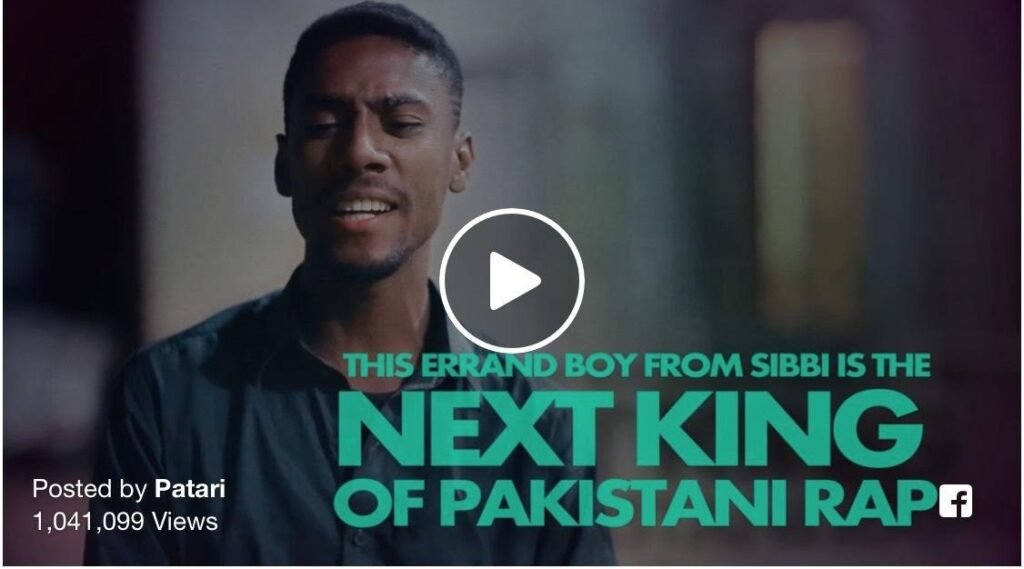
Once a large part of Baluchistan was part of the Sultanate of Oman and Zanzibar, including the musically highly prolific Makran coastal strip. The port city of Gwadar was bought from Oman by Pakistan as late as 1958. The whole region is now divided over current Iran and Pakistan. There is a palpable Afro-Baluch community. Baluch and descendants of African communities created fascinating mixed musical and ritual cultures. A recent sensation in Pakistan originated around Abid, a former tea seller from this community who could not read and write, and who became the “Emimen of Pakistan” as the media nicknamed him.
Abid, the ‘Balochi Eminem’.
Across the Indian Ocean
The Bodu Beru music of the Maldives derives from African music. Bodu Beru means big drum. The structure of the drum as well as the structure of the rhythmic patterns and its accompanying movements are clearly from African origin. In some of these cases, traditional trade patterns and not just slavery may be at the basis of such confluences. In my presentation, I honour the influence of African culture in general around the Indian Ocean and North-Africa, through music and rituals.
Mauritius has fascinating mixes of African and Indian music and Réunion has the popular Sega. One can find African musical and ritual culture as far as in Sri Lanka. Whole villages of ‘Kaffir’ (in Sri Lankan culture, not a derogatory word) still exist. They have their own music and dance cultures; among them the manja with its polyrhythmic drum patters and dancing have become fashionable in concert halls and night clubs.
The Afro-Sri Lankan communities were brought there as enslaved by the Portuguese colonisers. During the two decades on from 1638, the Dutch took over from the Portuguese and ‘freed’ the enslaved plantation workers in order to have them continue as ‘free’ labourers. This resulted in a certain relation of mutual understanding between the descendants of the enslaved and the descendants of the Dutch, still named Burghers. A name which is derived from the Dutch word for citizen.
A manja performance by Kaffir community members in a venue in Colombo
Elsewhere in and around the ocean, both the Portuguese and the Dutch continued slavery. There are documents in Amsterdam on how the Dutch transported Africans to Kerala. They also transported enslaved and semi-enslaved from Bengal and Indonesia to South-Africa. Among them were certain ‘radical’ Muslim scholars who were considered a threat by the Dutch. The muslim scholars’ descendants, for decades, would write in the Afrikaans language which was derived from the Dutch language, in Arab script. It would be rewarding to study the musical derivates of these migrations too.
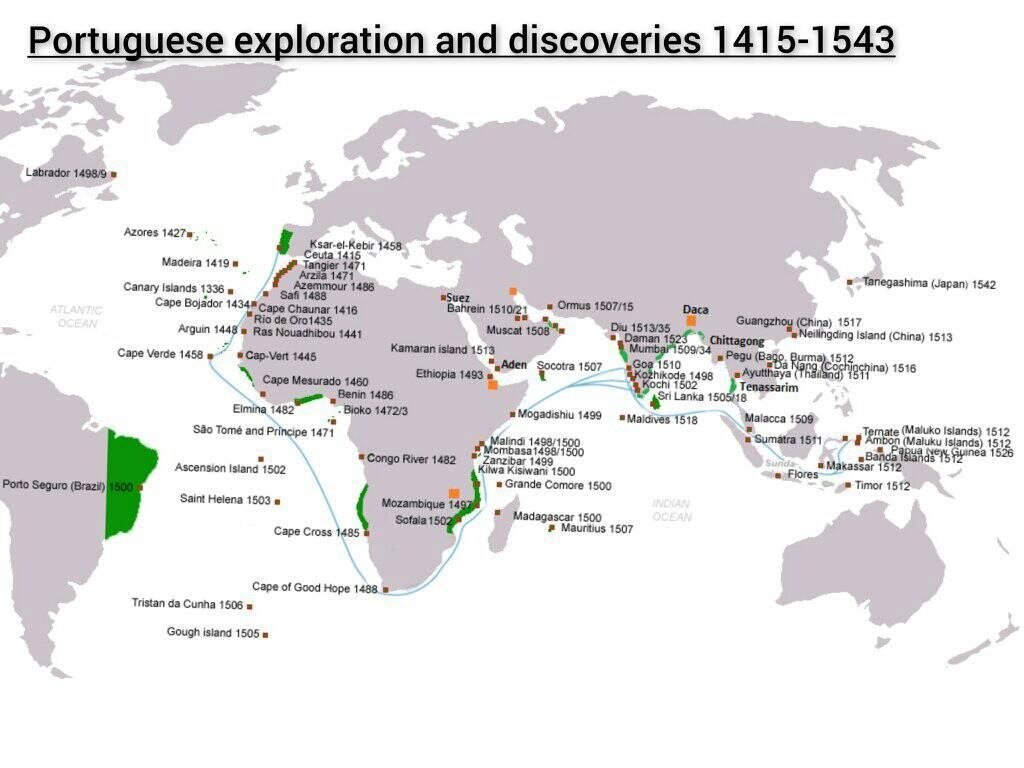
Map of the Portuguese trade routes and the colonisation around the Indian and the Atlantic oceans, named as ‘discoveries’.
Turkey
The Ottoman Empire also has its borders on the Indian Ocean via its areas around the Red Sea and the Persian Gulf. Directly or indirectly, peoples of African origin reached the areas that, after the carving up of the empire by the British and the French, remained behind as current Turkey. The city of Izmir has an Afro-Turkish community with its own rituals. They are descendants of former enslaved people who arrived through the former Ottoman Arab provinces. Esmeray was a famous Afro-Turkish singer and filmstar.
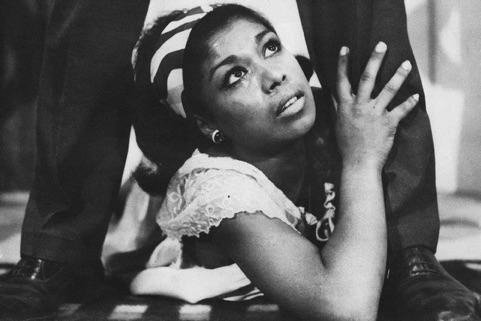
Turkish singer and filmstar Esmeray in a movie scene.
Dutch-Turkish photographer Ahmet Polat photographed the community, which led to various exhibitions.
As an example of ‘integration’, there is a famous picture of Ahmet Ali Çelikten, the first black pilot from Turkey and perhaps one of the first black pilots in the world.
There have been several studies as well as documentaries on Afro-culture in the region. But there are no comprehensive overviews, due to nationalism, language and the taboos surrounding slavery’s history. It is now time for an integral approach.
Further South-East in the Indian Ocean
Through the Portuguese, Dutch, British, or through Arabic traders, people of African origin reached even further South-East in the Indian Ocean as far as the Malaysian-Indonesian world. Recently in Malaysia, a movement emerged to preserve its creole heritage.
From the ArtDaily online magazine – “It was an era when tiny Portugal had a global empire and Malacca, a centre of the lucrative spice trade, was a key prize for rival powers. After Portuguese rule, the Dutch colonised it and later the British took it over until Malaysian independence. The city on Malaysia’s west coast still has vestiges of colonial rule which have made it popular with tourists, including red-walled Dutch buildings and a gate house which is all that remains of a once-mighty Portuguese fortress. Kristang has a largely Portuguese vocabulary but its grammatical structure is similar to Malay – the most commonly spoken language in Malaysia – and it is also influenced by Chinese and Indian languages. As well as in Malaysia, it is spoken by tiny communities in Singapore and Australia due to migration. But it has been in decline for years. The language is not part of the school curriculum and the Eurasian community has been steadily assimilated into the broader Malay-speaking community. UNESCO, which lists languages in peril, classifies Kristang as “severely endangered” and says only about 2,000 people speak it.”
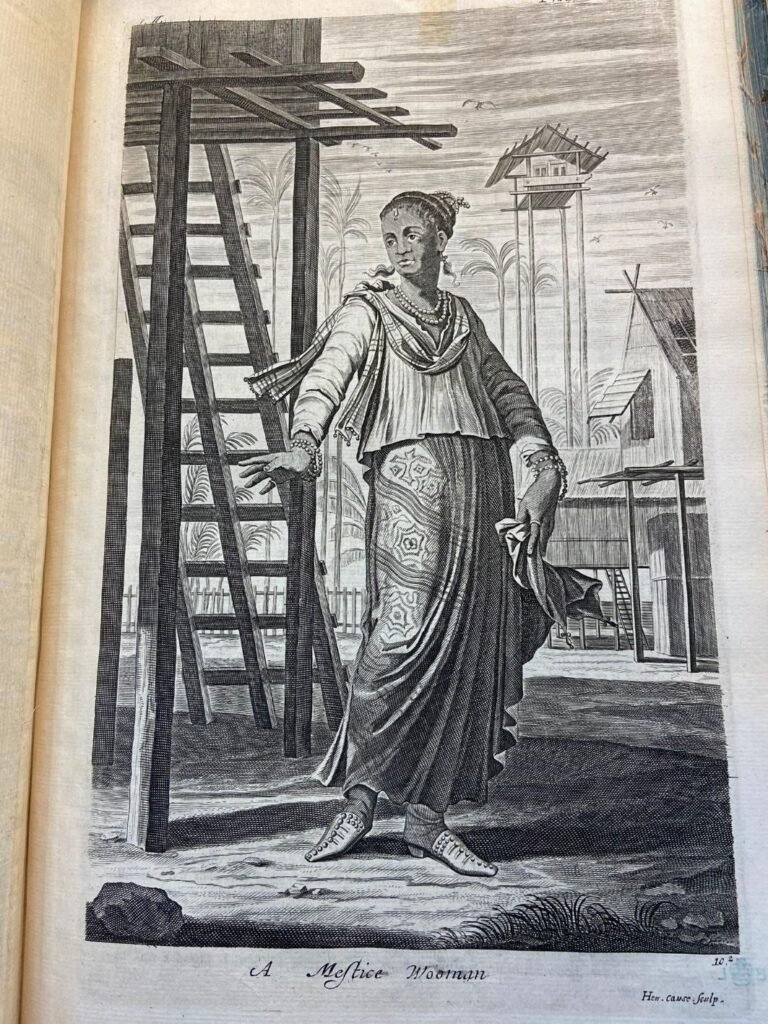
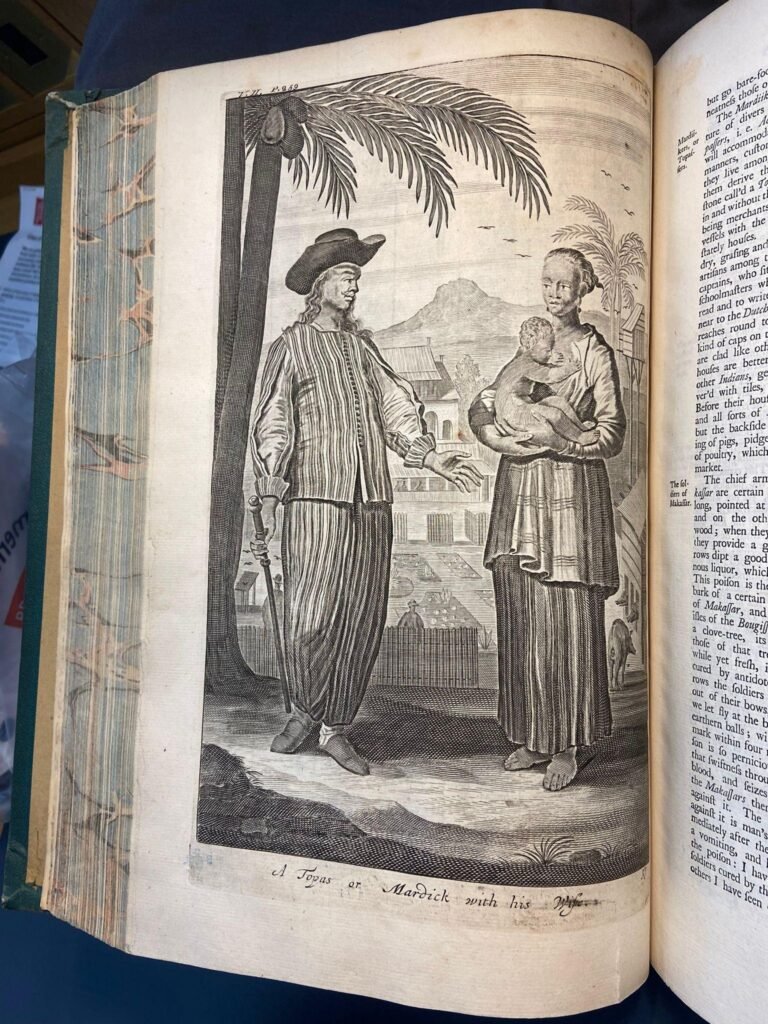
Received via Ananya Jaharana Kabir – Creoles from Batavia in the British Library special collections.
The Beit Jelmood museum in Doha hosts a collection dedicated to ‘the history of labour exploitation’, in a house owned formerly by a slavery trading family. Here, you can find some references to musical culture. There also is a copy of the famous lithograph, ordered by Dutch Orientalist Christiaan Snouck Hurgronje and made in the Dutch consulate in Jeddah (and not in Mecca as the museum states) around 1888. On it, we see ‘slavery musicians’, as Snouck Hurgronje had it, with the East-African tambura instrument. The instrument plays an important role in Zar and other music practices, and spread over many regions where African music influences pervaded.
Description in the museum of the famous Snouck Hurgronje lithograph.
Note by the author – However, the museum erroneously writes that the picture was made in Mecca, while it was assembled from photographs made in Jeddah.
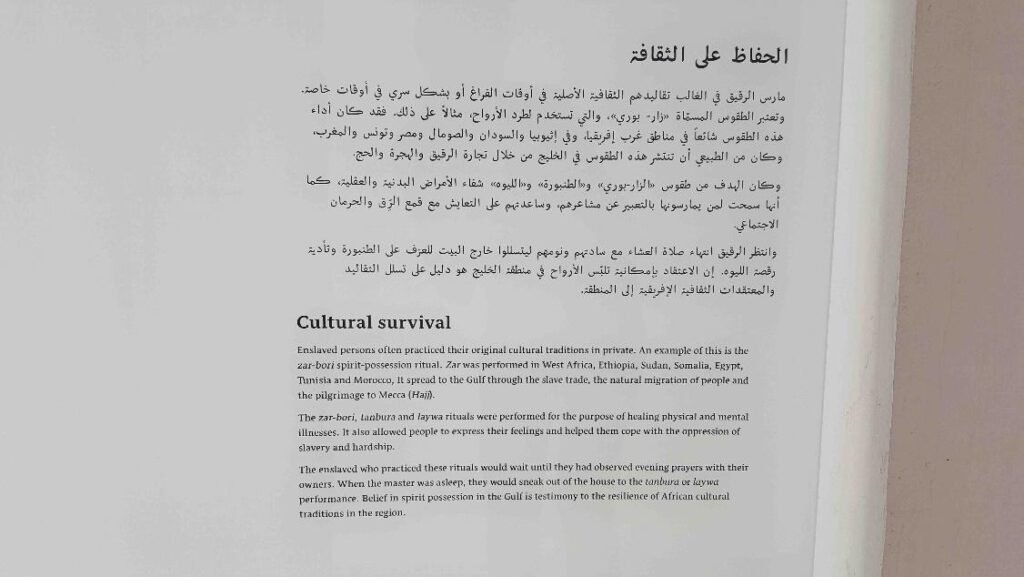
Information in the museum in Doha on Zar and Liwa.
Note by the author – The text mistakenly states that Zar exists in Tunisia and Morocco. Perhaps it was confused with Gnaoua. There are a lot of things that need further research, including the factuality of the information that is already around.
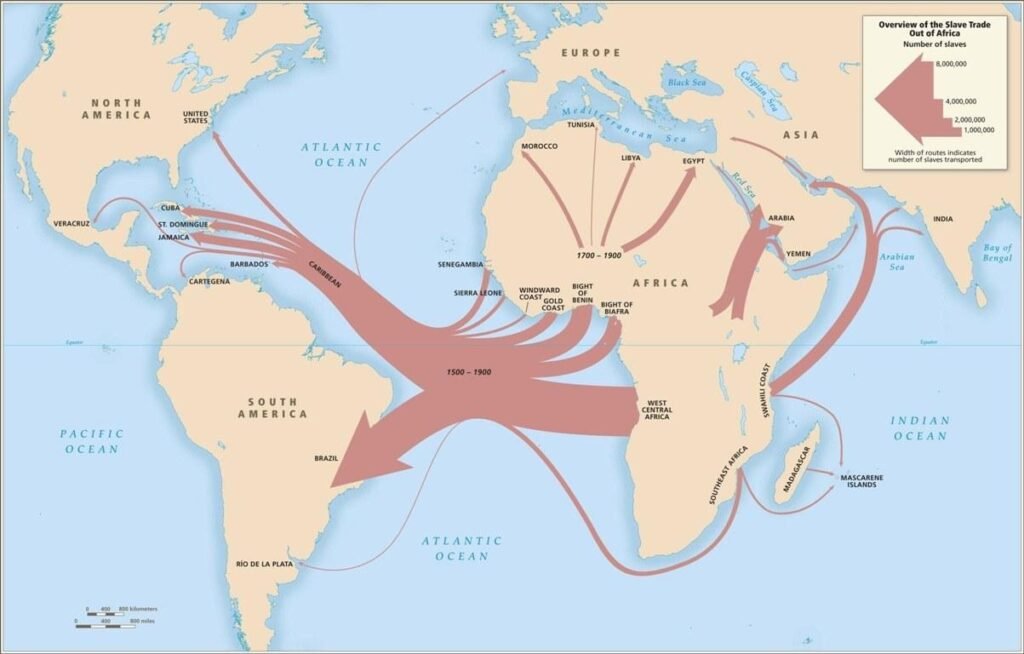
The role of the sub-Saharan African music culture throughout the wider regions is gradually receiving deserved interest. However, the role of slavery is still not always acknowledged and sometimes is still a taboo. But the due respect given to music is already a gain.
Epilogue
The first illustration I used was the famous lithograph commissioned by Christiaan Snouck Hurgronje, of a tambura orchestra in the courtyard of the Dutch consulate. This lithograph was assembled from photographs Snouck Hurgronje took himself. Recently, it turned out that the pictures were not taken at the Dutch consulate but in the inner city of Jeddah; maybe in a black neighbourhood. It was probably during a Thursday evening, when prior to the religious ceremonies of Friday, there was time for leisure. Things seem to have been quite exuberant in that part of the town.
Christiaan Snouck Hurgronje also made recordings with the earliest kind of audio-recording machines, and they might reveal a lot more about all this. The whole Snouck Hurgronje archive has been under embargo because in connection to some PhD studies, the collection is being catalogued.
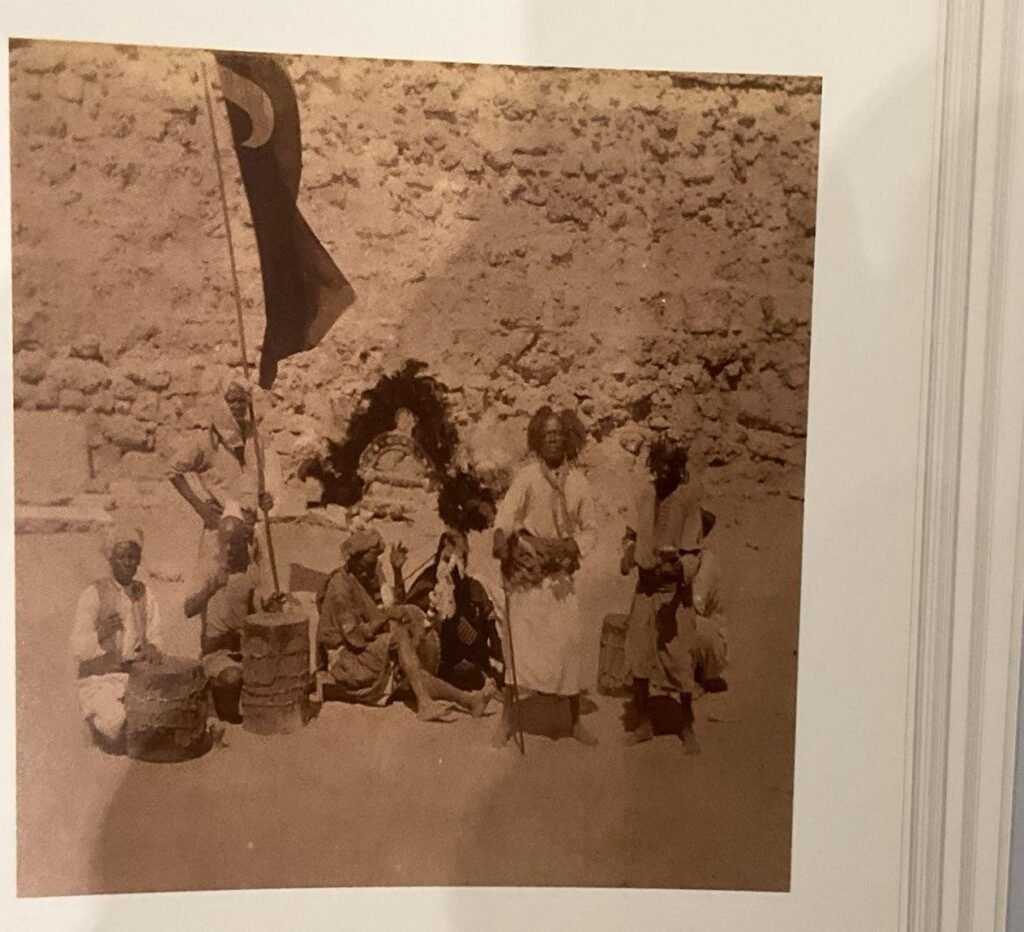
One of the photographs on which the lithograph commissioned by Snouck Hurgronje
is based.
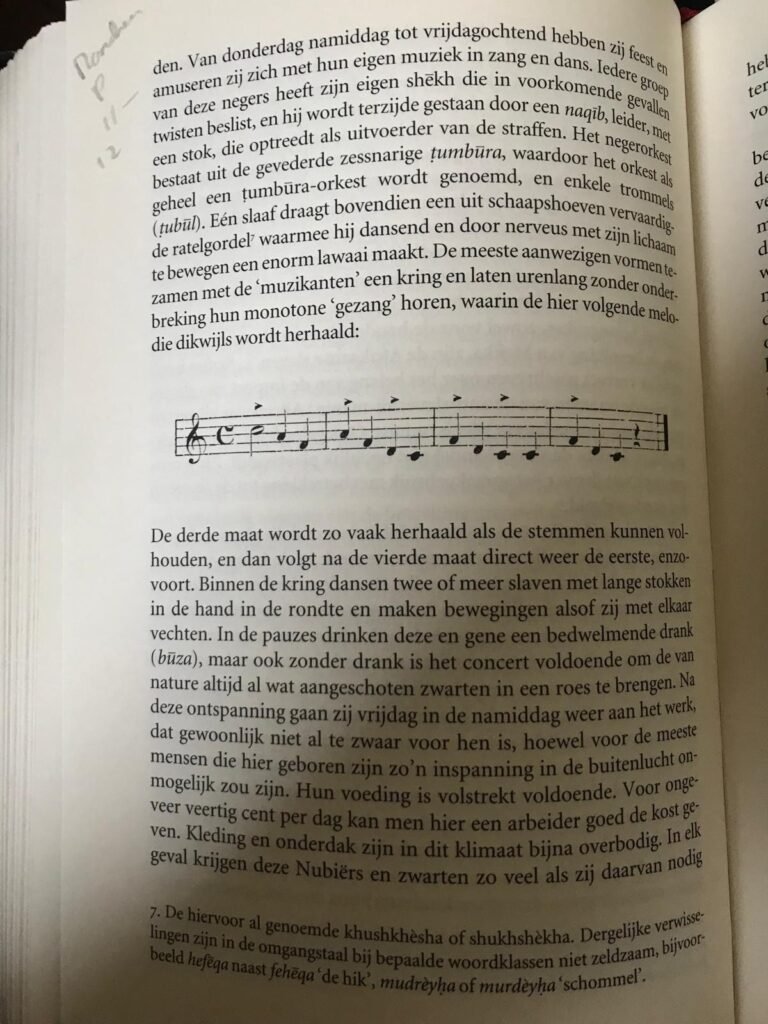
Page from the edition in modern Dutch language of Snouck Hurgronje’s book Mekka, with his description of the Thursday night to Friday morning parties in the black neighbourhoods of Jeddah.
Note by the author – In my text, I avoid the use of the word ‘slave’ and use ‘enslaved’ instead, and likewise avoid ‘slave trade’ by using either slavery, forced migration or human trafficking.
Slavery certainly is not over; nowhere in the world. In fact, this is one of the messages expressed in the Beit Jelmood musem in Doha. The perils and dangers of the past continue in the present. Saidiya Hartman notes that “even now lives hang in the balance. Slavery had established a measure of man and a ranking of life and worth that has yet to be undone”.
Neil van der Linden
Amsterdam, October 2024