
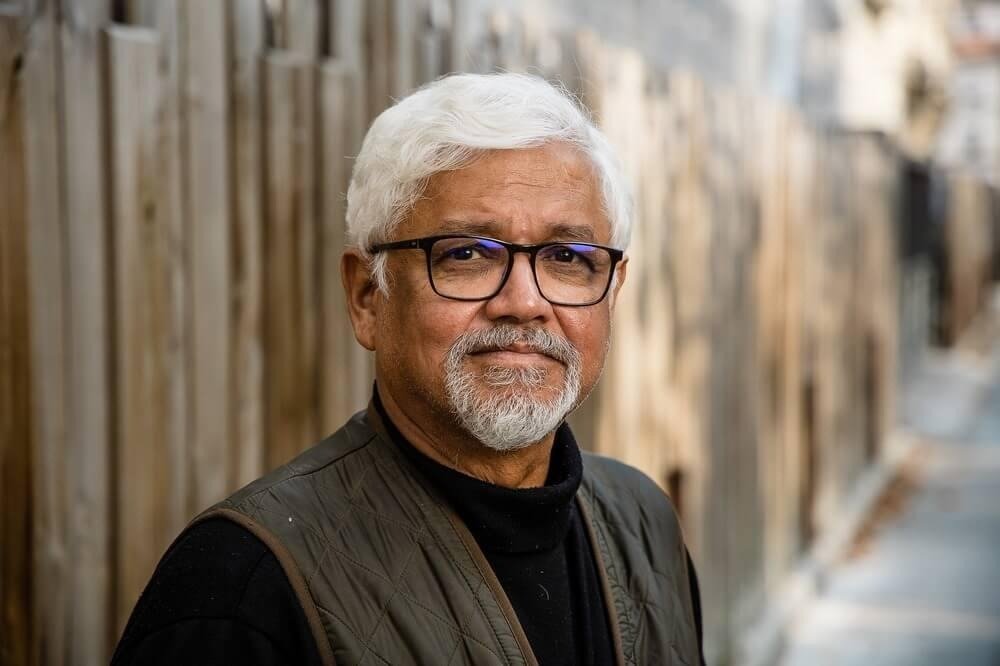
Amitav Ghosh discusses the unsettling realities of climate catastrophe and global displacement, along with an exploration of polyglot cultures and the role of storytelling in reimagining human and more-than-human histories with Professor Nishat Zaidi and Professor Dilip Menon.
https://www.youtube.com/live/tQQF0O3KB4M?si=lzk-XgNIGwJfzbD9
Introduction
Amitav Ghosh is one of the most influential contemporary Indian English writers, known for his historical fiction and writings on climate change and migration. Ghosh received India’s highest literary honour, the Jnanpith Award, in 2018 and was also awarded the Padma Shri in 2007. Internationally acclaimed, he won the Dan David Prize in 2010, was elected Fellow of the Royal Society of Literature in 2009 and received the Erasmus Prize in 2024 for his writings on climate change. His major novels include The Circle of Reason (1986), The Shadow Lines (1988), The Calcutta Chromosome (1996), The Glass Palace (2000), The Hungry Tide (2004) and Gun Island (2019). He is especially celebrated for the Ibis Trilogy comprising Sea of Poppies (2008), River of Smoke (2011) and Flood of Fire (2015), which examines the Opium Wars and colonial trade across the Indian Ocean world. His important nonfiction works include In an Antique Land (1992), The Great Derangement: Climate Change and the Unthinkable (2016), The Nutmeg’s Curse (2021), Smoke and Ashes: Opium’s Hidden Histories (2023) and Wild Fictions (2025). In 2021, he also published Jungle Nama, his first work in verse based on the Sundarbans legend of Bon Bibi
Interview
Nishat Zaidi: Amitav, it is often said about you that you are a Bengali writer who divides his time between Brooklyn and Goa, but you are basically a Mauritian at heart. Right from your first novel, The Circle of Reason, your writings have been engaged with oceanic life, life on board ships, ports, lascars, and so on and so forth. Ocean, basically, is present in all your writings not only as a metaphor or an image, but also as a material site which generates opportunities of affinities and also anti-colonial and anti-capitalist solidarities. If I may use Edouard Glissant’s phrase, “one feels there is an archipelagic imagination at work” in your writings. So how did you turn to ocean and oceanic imagination, and how has this oceanic imagination helped you recuperate subaltern narratives?
Amitav Ghosh: When I started writing my first novel, The Circle of Reason, I was in Trivandrum actually, in Southern India, and the book is about Indian workers travelling to the Middle East and then moving on to North Africa. In a way, the book charted my own travels because I had spent time in Egypt, and one of the most exciting things I ever did was to hitchhike across the Sahara on my own. This was way back when such things were possible. I am talking about 1979. This was a time when I was learning Arabic in Tunisia. All those experiences left a mark on me, but I think one of the experiences that profoundly affected my whole life was that, as a child, I spent two years in Sri Lanka. I studied there and I was very young, between the ages of nine and eleven. The English that I grew up with in Sri Lanka was the trans-oceanic pidgin of the Indian Ocean. It had an extraordinary flavour. It is kind of hard to explain. It was a kind of pidgin which was riddled with a lot of obscenities and it was literally a kind of sailor language. Now, when I go back to Sri Lanka, I don’t hear it spoken in that way, not the way we used to speak it when I was a kid, and I think that profoundly left a mark on me. When I started writing my Ibis Trilogy, for example, I really drew upon my memories of that experience. The ways in which pidgin languages have circulated in the Indian Ocean, I think, is really one of the most extraordinary phenomena and, as with all pidgins, a lot of them are sort of re-lexifications of older structures. So, I think that is a huge linguistic resource that we had in this whole Indian Ocean world and it is something which continues to fascinate me to this day.
Dilip Menon: Actually, we will come back to this question of the multiple registers of language in your work, but just to begin with, when we look at the changes that are happening in the world, the first time we managed to spend some time together was in 1984. A few of us had gone to Oxford on a scholarship, you came to visit, and it was shortly after Indira Gandhi was assassinated. I remember you talking about what was happening in Delhi, the pogrom and the smoke rising on the horizon, which you have subsequently written about. But a lot of us left India at that time. It was almost as if we had left India behind and that India had changed beyond recognition. And then you realise, as time went on, that we are a bit like the angel in Paul Klee’s Angel of History, that from 1984 to the present we have been blown backwards looking at the debris that is accumulating, in some sense, in India, the debris of secularism and the multiple things that we could talk about. How do you relate to this turbulent history of the last 40 years or so in India and how do we relate to this? Because there is some sense, as a writer, that a lot of your writings try to escape from the prison house of the nation through summoning up earlier imaginations, the lives and movements of people which always exceed the nation in some sense. And what attitude should we have towards this? There is a way in which you can look with a sense of nostalgia towards the past, that the past was always better. You could be cynical, and a lot of us have increasingly become cynical, that there is not something particular about the present. But there is, in your writings, the hope that this churn will move us past these tired paradigms of thinking. So, it is actually a question of how you relate to these changes that have been happening in India in particular, how that reflects your writing and thinking about earlier imaginations, vast spaces, and perhaps you could talk to us about this.
Amitav Ghosh: I remember being at Oxford and all of us speaking in 1984. It was after the riots and those riots in Delhi were profoundly a formative experience for me, and I think for all of us who had been there, just to see the sort of horror that unfolded around us. I did eventually write about it, but I didn’t write about it until nine years later because it was really a deeply traumatising experience. I left India in 1988 for a couple of years and then returned later in 1990, but this period, I realise when I look back on that time in my life, I was really traumatised in that year. How I responded to it, I feel in retrospect, I can only explain to myself as trauma. And it was a trauma of many kinds. There was political violence and there was also the trauma of pollution in Delhi, even back then. I remember that time when I travelled to London in 1984-85 approximately, just your head sort of streaming with all this muck that would come out and, of course, over the years it has only gotten worse. It was a time of horror but also a time that was very formative because, in those years, Delhi was intellectually an incredibly exciting place between the late 70s to the late 80s. When I went to Oxford, it was socially a lot of fun but intellectually it was kind of dead compared to Delhi. I had read everything that my teachers wanted me to read and it was kind of funny in that way. This period of extreme violence really culminated in 1990-91 during Babri Masjid. That was a kind of climactic episode of violence that brought this particular period to an end. But we can’t forget that after that, between 1993 to 2010 or 2011, there was an extraordinary time of exception in India when we had almost like 20 years of relative peace, an incredible change in people’s lives, a sort of new kind of prosperity for many, though also, of course, immiseration for many. But the most important thing in those years was that there was communal peace. Not without exceptions, but there was nothing as traumatizing as there was in the 1990s. I think that time is absolutely over now, and it is not just in India but I feel the same about the USA. If you look at the 1990s, 2000, 2010 period in the USA until 2016, it was again a time of normalcy. But that normalcy is gone everywhere in the world. And for those of us who have been following climate issues for a long time, I knew, when I was writing The Great Derangement, that the world is heading towards a great unravelling. How and what form it would take, I didn’t know, but that is exactly what we are seeing today. Climate scientists, when they talk about the atmosphere’s sensitivity to anthropogenic greenhouse gas emissions, they are talking about the climate system. But I think the political and social sensitivity to climate change is actually much greater than that of atmospheric systems. And for this we only need to look back on the 17th century and the Little Ice Age. If you look at just one degree variation in global mean temperatures, it created such absolute mayhem across the world, civil wars in England, Russia and China, the overthrow of the Ming. Actually, one of the few places in the world that was relatively peaceful in the 17th century was India, and much of the credit for that goes to the Mughals. I wonder why nobody talks about this or writes about this because the Mughals were actually very sensitive to climate, even the art of that period. They created granaries and they had an intense awareness of climate change, and they created all of these interventions by distributing.
Dilip Menon: When you summon up the image of the Mughals, just as much as your writings summon up the idea of geographies, other histories and other movements and so on, do you see writing as a form of therapy against this gathering storm or the storm in the middle of which we live? The world seems to have changed beyond recognition but your writing seems to summon up other worlds that existed, and worlds that are possible. I mean, is there something about writing that is therapeutic in that sense?
Amitav Ghosh: I don’t think writing is at all therapeutic. It is something that is profoundly disturbing. I mean, for me writing has always been that. When you write, in 1984 for example, it is one thing to live through it, but writing about it, or writing about that kind of violence when I was writing The Shadow Lines, it really grew out of the 1984 riots because it made me try to remember the role of communal violence in my own life, in my own childhood and so on. It was there in Sri Lanka, it was there in Bengal, and writing that book was traumatising, as was In an Antique Land. I wouldn’t say that writing for me has ever been therapeutic. Writing is where you really struggle with what you see around you. It becomes real. Similarly, writing about climate change was again not at all therapeutic. Rather, it created an upheaval in my life and my way of looking at things. Again, that was one of the things which made me write The Great Derangement and the book that I am writing now. I am correcting the proofs right now and it will be out in September. It extends and enlarges on many of the themes of The Great Derangement through Indian Oceanic history. But just looking at all that, I can’t say that writing is at all therapeutic. But for me now, it is a practice. It is what I do and I couldn’t stop. And, in that way, writing through this pandemic has been therapeutic in some way. I mean, it certainly kept me intensely busy, and it kept me working and thinking in ways that I haven’t been able to do in a long time.
Dilip Menon: I remember again a rather uncanny occasion when, after you visited us in Oxford, we went off to the pub, The King’s Arms, for beer and suddenly Michael Gilson, who was a Professor of Anthropology, walked in and the two of you started speaking to each other in Arabic. So an Englishman and a Bengali meet in a pub and they start speaking in Arabic, and I think there are a lot of these encounters that happen in your novels where, in Gun Island, for example, there are characters in Venice speaking Bengali because suddenly Venice is full of Bangladeshis. Then you think about the island of Capri at some point, and there were all those Sri Lankan Tamil refugees speaking Tamil in an Italian space. I think these kinds of encounters that you speak about are about the polyglot nature of the world, about people connecting despite language and also because of language. There is something there about writing, about the world as it is. I mean, this is the nature of the world, but most of our imagination seems to be monolingual. We tend to read in singular languages and we lead singular lives, but there is a lot of life that’s lived amidst languages, engaging with languages and so on. So I just wanted you to reflect on it. Is this something that comes through your personal experience of travel, for example, people speaking multiple languages to each other, or is it something done consciously? You invent a whole language in the Ibis Trilogy. I mean, it has traces of Hobson-Jobson and it has traces of the lascar, but it’s also something that’s wholly and delightfully invented. So what’s the function of language in the way you write and what you write?
Amitav Ghosh: Well, interesting question. Let me say first of all that it’s interesting that you remember that incident with Michael Gilson. See, in a way it’s not surprising because Arabic is and always has been a global language. It’s an international language, spoken everywhere partly because of the Islamic traditions. But Arabic is an international language, so when you meet someone and start speaking in Arabic, it’s not really that surprising. Bengali, on the other hand, is spoken by as many people as speak Arabic, but Bengali is not an international language. You don’t expect, growing up as a Bengali speaker, to meet someone and start speaking to them in Bangla in some faraway place. It just does not happen. It’s not like that. But that is one of the most startling changes that has occurred over these last 30 years. I now hear Bangla everywhere in Brooklyn, for example. All the people who are just walking down the street, I hear Bangla. The people who restore the brownstones are all Bengalis. Many of the people who work in shops are Bengalis.
So, we speak Bangla with each other, but again, when you first address another Bangla speaker in Bangla, they are always taken aback because Bangla is a language of intimacy. You speak it with people you know speak Bangla. You don’t expect a stranger to speak Bangla. So it often happens in New York. I’ll get into a taxi and the taxi driver is a Bengali. He takes me not to be a Bengali or something. He does not expect that a stranger will be able to understand what he’s saying. So, you know, they are on the phone with those Bluetooth things and you hear them having these most incredible personal conversations, which they would never have about their girlfriends or whatever, and they don’t expect that you’ll understand. So when I get out at the end, I always tell them, “You speak very clear Bangla. Thank you, that was an interesting ride.” For them, it’s like you have fallen out of the sky. They can’t believe that you understood what they were saying, but this is something completely new.
Similarly, I’ve been going to Italy for a very long time, but it’s literally over the last 20 years that you have started hearing Bangla everywhere in Italy. So, I was spending some time in Venice, and that’s when I really noticed that everywhere around me everyone was speaking Bangla. But it was not just Bangla. They were speaking the Madaripuri dialect of Bangla, which I used to speak with my grandmother, so it was completely uncanny. I had not spoken that dialect in decades, but I recognized it. It was so moving and again so uncanny. So, I think the book Gun Island really grew out of these kinds of extraordinary encounters, and I began to ask myself what is going on, what is this enormous displacement that’s actually happening.
You remember that European so-called migration crisis that started in 2015. When you read about it, the sort of media discourse on it was that all these people are fleeing war-torn areas and so on, and they are fleeing from Sub-Saharan Africa. But if you looked at the newspaper pictures or at the television footage, anybody could see that, I mean at least I could see, that many of these refugees were in fact South Asians and I could even see that they were Bengali because Bengalis recognize each other, just as we all do, I suppose. So, I became very puzzled by this and I thought, what is going on? Because Bangladesh may have its problems, but it’s not a war-torn area by any means, and in fact they have overtaken India now in their GDP and per capita GDP, etc. It’s one of the fastest growing economies in the world, a huge success story, says Kaushik Basu and The Economist. So, I became very intrigued by this and I went off in 2016 to Italy and I travelled around all these refugee camps and their whole sort of system of reception of refugees, interviewing people, these young men, overwhelmingly young men, who cross the Mediterranean in these rickety boats. It was a really eye-opening experience for me just to see what was happening and what was underway, and it completely linked back to the 19th century, to Indian Ocean networks, to the lascar profession. It was really eye-opening in so many ways because the first Bangladeshis to come to Veneto, the region of Venice, were actually lascars, as for instance happened in New Orleans and in New York. I am sure some of you will know the book Bengali Harlem, where he takes up this question of how the lascars settled in various places. The lascars who went to the Veneto basically went into the shipbuilding yards near Venice in Mestre, and that’s where still most of the Bengalis live, so it’s a very interesting thing. This entire movement is so much rooted in history, but also in the present day, in climate displacements and political conflicts.
Nishat Zaidi: Amitav, you talked about refugees and using that trope I will take you back to the question of oceanic imagination and archipelagic imagination. In hindsight, one feels that you seem to have planned all your books even before you set out to write, I mean the way one sees the connection between your first book and what you are writing today. You have been engaged with refugees and your engagement with refugees is not something new. Right from your first writings you have been engaged with questions of displacement, people who migrate, people who are displaced, the subaltern, the people on the margins of history. So is there a link between your engagement with the ocean, or does oceanic imagination help you retrieve and recuperate the lives of these people who are on the margins of history?
Amitav Ghosh: I suppose really that my own family history of displacement, my own sense of the history of Bengal, really all of it feeds into this inevitably, I think, for all of us who come from those parts of India that were partitioned. These are very vivid and just woven into the texture of our lives, these experiences, and certainly my personal experiences of travel and so on. So I absolutely feel a tremendous interest in this displacement, I always have. I feel it more and more now. One of the things that really disappoints me in the coverage that I see globally about displaced people is that almost all of it is written by Westerners who don’t speak the languages of the people who are displaced often. For example, one of the reasons why South Asians never figured in this sort of media narrative of the European migration crisis was simply because very few of the journalists spoke Urdu or Bangla or Tamil. The discourse that the refugee presents when you are speaking to them in their own language is completely different from the discourse that they present when they are speaking any kind of official language. It’s absolutely different. You see a completely different and fascinating story emerge, to me at least. I think it’s important to get into the nitty-gritty of these things. Apart from being an anthropologist, I was a journalist for a long time, so my books don’t actually start with a great plan. I didn’t plan Gun Island. When I went to Italy in 2016, what took me there was much more a sort of journalistic interest. I was just curious. I was just wondering why and what is happening here, why aren’t people writing about it? I think there are many mysteries. I find it so strange that Indian journalists do not go off to look into this because one of the really bizarre things is that if you go to these refugee camps, there are masses of Bengalis, Bangladeshis basically, Hindu and Muslim Bangladeshis, and there are masses of Pakistanis. You won’t believe there is a huge refugee camp in Sicily, in a place called Caltagirone, an old town with a refugee camp which is almost entirely Pakistani. For some reason Pakistanis from all across Europe make their way there because of networks. But again, when you speak to the Pakistanis, you can see so clearly the impacts of climate because many of them were displaced by the Jhelum floods. I had never heard of the Jhelum floods, my Pakistani friends had not heard of the Jhelum floods, but the river flooded in 2014, displacing masses of people. But the Indians, on the other hand, are very few. Not only did I not meet any Indians in these camps, the Pakistanis and Bangladeshis I spoke to also generally did not meet Indians. When they did, the few Indians that they remembered meeting were almost always Punjabis. So, there you see already the role of networks and historical networks because the whole Bangladeshi movement is actually facilitated and enabled by global networks that go back to the 19th and 18th centuries. The whole lascari history has a lot to do with it. Similarly, the international networks of Pakistan and the Punjab were both enabled by sepoy history. So, it was the British Indian Army that created these networks for Punjabis initially, and those are the networks that now facilitate movements. Most Indians, the great majority of Indians, don’t actually have those international networks, but I think they will soon, and once that happens, you’re going to see an even greater churn in these movements. For now, the movements of displaced people in India are mainly internal. Many of you will be aware that there’s been a huge demographic churn within India so that the working class today of Goa is almost entirely from the east, mainly Bengali. All along the east coast or the west coast, the working class has been replaced by easterners. There are schools in Bangalore where the majority population of children speak Bangla, not Kannada. There’s a huge demographic churn going on and the authorities and even the newspapers seem to have only realized this when that horrible travel ban was imposed during the pandemic. But in fact, anyone who has been keeping their eyes open would have noticed this, and again, to come back to your question, I noticed it because of language. In the village where I have a home in Goa, a small village quite isolated, suddenly over the last ten years you hear Bangla being spoken more and more by the workers. The only restaurant in the village is run by Bengalis. It’s an extraordinary phenomenon.
Nishat Zaidi: Speaking of this demographic churn that you referred to in your works like Gun Island or The Great Derangement, and in your various lectures, you have spoken about the dangers of the capitalist economy, such as globalization and the refugee crisis, and you have tried to draw attention to a fragile relationship between humans and earth systems. You also spoke about this habitability question. In your book The Great Derangement you referred to Latour quite frequently. He says that the Anthropocene is the crisis of modernity. Do you concur with this position? Is that the reason why you turn to premodern culture and texts? Is your idea of the Anthropocene a result of your engagement with the Indian Ocean world because oceans have borne the brunt, as you have been repeatedly pointing out?
Amitav Ghosh: Latour, as he sees it, modernity is really the crisis. The modernity he is talking about is really the crisis of the 19th and 20th centuries and perhaps the late 18th century. I think it actually goes back much further, and it’s in that sense that it’s very much an oceanic phenomenon. I think that the crisis really begins in the 16th and 17th century, so I would say that it’s a crisis that is profoundly rooted in the early modern era. The more you look around at all the phenomena that are unfolding around us, the clearer the connections become. So, I think the crisis really begins ultimately not as a crisis of capitalism because capitalism only comes into being in the 19th century. I think it’s a crisis of imperialism. It’s a crisis that begins with the empires, with the earliest European voyages. I think the historical lines are quite clear and I don’t know why historians don’t make this argument more forcefully, but certainly it’s the argument that interests me very much. I think this whole idea of capitalism is a kind of evasion. I don’t know if any of you have ever read Priya Satia’s book Empire of Guns. It’s a really brilliant book. I think it’s a pathbreaking book and really should be read, and it should also be read in the context of Cedric J. Robinson’s work on racial capitalism. What Priya Satia demonstrates is that the driving force behind the Industrial Revolution is armaments and the manufacturing of guns. The manufacturing of guns in England creates the condition in which industrial and technological breakthroughs take place. All the major innovators of that period are actually financed by a guy called Galton, who is a Quaker. He is a Quaker who is running the biggest gun-making operation in the world. The way that the English depress industrialism in India is not by cutting the fingers of the weavers and so on. It’s actually by depressing the production of weaponry, by flooding the market in one way and by killing off gun-making inside India. It’s a brilliant book. The idea that capitalism is somehow prior to imperialism or that it is somehow logically prior to empire, I think this is a completely false notion. If you look at the 17th century, what is actually being put in place is what Cedric Robinson calls racial capitalism. It’s the racial structures that are put in place that enable capitalism to emerge. Even if you talk about the late 19th century, how can you talk about capitalism without talking about slavery, talking about various forms of bondage under which all those raw materials are produced? The idea that capitalism is somehow a self-sustaining system that’s endemic to Europe in some way, I think it’s a completely false notion, and there’s so much work now being produced that shows us this. It’s interesting whom Cedric J. Robinson ultimately thanks in his book on the Black Radical Tradition, which is Kamala Harris’s mother, as she was evidently very close to his circle. It astonished me when I saw it. Can you imagine this little Iyer lady from Tamil Nadu going off there, getting at once involved with this incredibly radical Black circle in California? But she was obviously a remarkable woman. Cedric J. Robinson says that the reason why Western radicals like to talk about capitalism is because it allows them to evade all the really ugly stuff, and I think that’s true.
Nishat Zaidi: So, what you are saying in a way is that imperialism, capitalism and modernism are linked to each other in one way or the other. How does fiction respond to it? Because you mentioned in The Great Derangement other Indian writers, Bengali writers, but I am thinking of Intizar Hussain who rejects the label of modernist fiction and says that he finds the Jataka a lot more modern. He claims that, “after reading the Jatakas the humanism of 1936 appears sectarian to me. In the Jatakas human beings are not a separate community; all creations are one community.” So, by placing human agency under the scanner, what kind of mode of being do you envisage in your writings because we are thinking of the relationship between humans and the earth systems? Modernity, capitalism and imperialism have altered it from the way it was in premodern society. Do you see a larger epistemological objective in exploring these connections between Africa, Asia, the Middle East and China, especially those which are created through oceanic exchanges? As a writer from the Global South, how do you respond to this?
Amitav Ghosh: There’s like an encyclopedia of questions in there. I don’t know which one to respond to first. I did not know that Intizar Sahib said this. Where does he say this?
Nishat Zaidi: He says this in his essay which is titled “Nay Afsane Nigaro Ke Naam,” addressed to the “new story” (Naya Afsana), so modern stories in Urdu. So he is addressing this to modernist short story writers who accused him of using Sanskritised language. Some of them even accused him of not writing in Urdu and writing in Hindi, so he just lambasts all of them. He says that “I don’t care about your kind of modernity or modernism.”
Amitav Ghosh: That’s so interesting, and this is exactly the conclusion that I’ve come to really in the process of writing The Great Derangement. It seems to me now that the whole literary tradition of Western modernity is completely complicit with imperialism, capitalism, and with all of those things. They are just reflections of each other and that’s why modern literature has been so slow to respond to the planetary crisis that we are in today. I completely agree with Intizar Sahib’s conclusions. After I finished writing The Great Derangement, that’s when I began to think that I have to go back to pre-modern literature. So, since the only other language that I have is Bangla, I started reading pre-modern works in Bangla and what he says is absolutely true. If you look at, for example, Manassamangal Kavyas, they are so responsive to all the forces of the earth. Devi herself is, as it were, the voice of other beings. It’s a very ancient story that actually predates Brahmanical Hinduism and it’s a story that actually conceptualizes the fundamental conflicts of our time so clearly. This conflict between the human urge for profit and the needs of other beings is conceptualized in the story with complete clarity. I don’t know if any of you have read the Indigenous American botanist Robin Wall Kimmerer. She is a wonderful writer and she has written an absolutely marvellous book called Braiding Sweetgrass: Indigenous Wisdom. In that book she says Indigenous traditions all over the world always talk about how do you limit what you take from the earth and she says in English there are no such stories and that’s really true and that’s why I wanted to write Jungle Nama, that is what it’s about. It’s a true forest story in that way. It’s a story about how to maintain the balance between the needs of earth and the needs of humans. It was very exciting to do this because again you begin to realize, as a storyteller yourself, that there is something so profoundly out of whack when our young people today have so many stories that tell them, “Oh be ambitious, you need have no limits, just do it, impossible is nothing,” and so on. Where are the stories that tell them, “No, you must have limits, you must learn to find some sort of contentment in life which is not all about discontent.” What’s capitalism about? It’s a great machine for creating discontent, you want more, more and more. Now, where are the stories that tell you “no”? And in that sense I completely agree with what Intizar Sahib said. I mean these earlier stories, these pre-modern stories are actually much more real, they are much more responsive to the earth and to the crisis that people faced in those days than our contemporary literature is. You look at contemporary literature in India now, it’s all written by urban people who have no awareness of what’s actually unfolding. So, I do think that as a writer I always identified myself as modernist and so on and I would have been proud of it and I would have thought that what modern literature does is it holds the human condition up to a kind of clear-eyed examination and that’s exactly what modern literature is. In many ways it’s a form of concealment of the crisis the world is in. It’s equally true of the entire humanities.
Dilip Menon: I think this is a fundamental point that’s always forgotten, like the fact that you insist on looking at the idea of the modern through the idea of violence, colonialism and the kind of effacement of this in the ways in which we think about literature as being a space that’s free of this detritus of colonial violence. For example, colonialism and the operation of power is central to your novels in many ways. It disrupts lives just as much as it creates new geographies and if you think about The Glass Palace, the Burmese war, the Opium wars and the Ibis Trilogy, there’s always the kind of accompanying hum of violence that goes alongside the creation of the modern world and the creation of the British Empire. Dipesh Chakravarthy and you had carried on a correspondence regarding 1857, the great rebellion, sepoy mutiny, however one chooses to call it, and regarding the nature of colonialism. I think where you and Dipesh departed was in your pointing to the underside of the Enlightenment, the idea of the Enlightenment as it were saying that Western violence was central to the formation of the world and I’d just like you to speak about that because I thought, and even at that point and I read it as a historian, I was very conscious that it called to me in a way that Frederick Robinson’s work calls to us, Eric Williams’s work calls to us. So what do these phrases that are current now about postcolonialism, decolonization, the decolonial, all of that mean to you, when you think about the centrality of Western violence in the making of the world? Recently there was a book on China which does not use the word Anthropocene, it calls it the Caucasocene, from the Caucasian people. So, I think there is a whole set of ideas that you have raised there, particularly the idea of violence and I’d like you to speak a bit more on that.
Amitav Ghosh: It’s interesting that you say that because what you are absolutely right about is that my fundamental disagreement with Dipesh, and it was a very respectful disagreement and I greatly admire his work, is that he effaces, I felt, in that book, racism and violence and I think a lot of Indian historians don’t take those things into account and I have a theory about it. The whole background of martial races and so on, and Bengalis and South Indians were not generally accounted within those martial races and so many historians are actually from Bengal and South India. So, they don’t have familial memories of violence because what the British were very skilled at was concealing the violence. The soldiers were always put away in cantonments, the ordinary civilians hardly ever saw soldiers but all around them was this railway network built. You start a little murmuring and a whole regiment would turn up overnight because the whole network had been constructed in that way. So, I do feel that way. You must have read The Garrison State. India was a garrison state. It was completely highly militarized and a military state. Everything about it was military but how much military history is there of India? It’s just a tiny segment of our historiography. It’s tiny, neglected and it’s treated generally as social history rather than a history of violence as such. When I was writing The Ibis Trilogy I was so shocked to discover that almost nothing had been written from a military point of view about the First Opium War, which was fought largely by Indian soldiers. There were like four thousand British soldiers, four thousand Indian soldiers but there were twenty-five thousand Indian camp followers who made the whole thing possible and yet there was no military history of the First Opium War written. You would think Indian historians would be rushing to write it but it has not been written. I had to literally recreate that history myself and actually if you consider the history of Asia, what is more important than the First Opium War? It leads to the complete transformation of China. There’s a direct line between the First Opium War and today and yet we live in such denial about it. The First Opium War was financed by Bombay merchants, and it was fought by Indian soldiers. Even most of the transport ships were crewed by Indians. I mean the entire infrastructure is from India and yet it’s as if it never happened. So, I do feel that this is a real issue in relation to historiography. I have mentioned Priya Satia before, her Empire of Guns, but she’s just come out with another book which is I think in many ways even more brilliant. It’s called Time’s Monster. It’s completely brilliant and I mean for the benefit of others who have not read it, it’s really about the creation of history as a discipline and how complicit it was. It was entirely a discourse of imperialism, it was a discourse of supremacy and that’s been a very interesting thing to see in this pandemic period. Here in Brooklyn, the “Black Lives Matter” movement was so deeply invested in history, even on those marches people were carrying placards which had footnotes linking to various kinds of history. So, that is the interesting thing. Until the 1960s or 70s, ninety percent of historical writing was about the so called historical nations which was all basically in the West. The histories were of very limited interest but that has really changed now. We are seeing a sea change, we are seeing an epistemological change and it’s interesting that the pandemic has brought it about and it has accelerated the whole process of rethinking our relations with the past.
Nishat Zaidi: You mentioned Priya Satia and another uncanny coincidence, we had Priya Satia’s lecture at Jamia today, of course online, so she spoke about her book this morning. Dilip is reading Priya Satia and Amitav was talking about Priya Satia. Going back to erasure of history that Amitav is talking about, I will touch the question of language because as it is clear from your writings that you are deeply fascinated by the phenomenon of language. From your discussion of Judeo-Arabic in In an Antique Land, to a melange of tongues that you discuss, you touch upon Ibis Trilogy and especially lascari which you have described as a profoundly eclectic tongue and in Gun Island again you turn to etymology. Etymology is another field that fascinates you. So, what does it mean to write polyglot fiction? How important is the idea of creole or creolization in your work, which tries to demonstrate that dialogue between people from across racial, regional and religious identities travelling in the Indian Ocean? It seems as though this dialogue was not simply metaphorical but it is also preserved in the polyglot tongues. So, is language a way of reaching out to those interconnections and linkages?
Amitav Ghosh: Thank you. That’s very interesting. Sure. I think the Indian Ocean has aways been a very multilingual space. So, I wanted to recreate some kind of simulacrum of that in the Ibis trilogy and in many of my other books but how do you do that? That’s the basic problem that we face, those of us who write in a monolingual form like the novel. You cannot actually have different languages in a novel. It’s not really possible, so what sort of solution is there to that question? It’s actually a very important question that even Sanskrit theorists confronted in very interesting ways and the way they theorized it was that you cannot actually create a multilingual text, it’s not possible, but their solution was that you use different registers of language. For example, certain kinds of characters would speak the Eastern Upper Brahmsa, while other characters were speaking Sanskrit and some others would speak the Western Upper Brahmsa, which are more or less understandable, comprehensible by everyone within a text. So my solution to the problem in the Ibis trilogy was to use various registers of English and fortunately there are so many registers of English available within the Indian Ocean space. There’s the Singaporean dialect, there’s the sort of lascari dialect and all the other sorts of registers of English. But the most interesting aspect of it for me was the lascari dictionaries which did not come about by accident. One of the really remarkable things about the whole technology of sailing is that it is very much tied to language because you know what happens on a sail ship. A captain or an officer stands on the deck and yells out an order and everyone has to respond immediately because if they don’t respond, we are talking about let’s say one hundred sailors, they have to respond immediately, so they have to understand what is being said. So, language is critically enmeshed in the whole technology of sail, which is why some of the earliest dictionaries going back to the 16th century and so on are actually nautical dictionaries. So, when I looked at crew lists of ships in the Indian Ocean and saw how multicultural they were, I said to myself they must have had some kind of nautical language and then I started to look and I said if there’s such a nautical language there must have been a dictionary and at that time I was visiting at Harvard University. They have fantastic resources so I actually found this Thomas Roebuck dictionary of lascari language which was completely fascinating for me. Honestly, because then I began to realize that so many of these words actually come to us through Portuguese and, of course, Arabic accretion but the Portuguese influence was particularly interesting to me because it’s so much a part of the texture of Indian life. What could be more Indian than a balti? At least when I was a kid we all grew up with baltis, bathing out of baltis, carrying baltis of water. Here it was astonishing to me to discover that balti is a Portuguese word. Similarly, what is more common than a mistry? It comes from the Portuguese. So many of the words, you know. So, in fact, Bengali, standard Hindi, and many Indian languages are also in some sense creoles.
Dilip Menon: Thanks, Amitav. I’d just like to end with a last question. It’s not a question that actually brings to a close the conversation. I’d like to admit that The Calcutta Chromosome is one of my favorite novels. I loved it, I have read it only four or five times. It also takes me back to my childhood and the kind of mystery detective novels that I read and it’s in the nature of a detective thriller. It’s science fiction and of course it spans the geography of empires. It keeps colonialism at the centre, going back to some of the things that we have talked about. In The Great Derangement you speak about how we stand with water up to our necks yet our imagination is unable to grasp or grapple with the fact of species annihilation and global warming. Even in science fiction, I mean it’s almost as if science fiction, which allows us to let our imagination roam free, exchange and engage with the exigencies of the future, somehow has a kind of lack and you kind of try to explain this by talking about the connections between Western capitalism and the kind of environmental degradation, the complicity of Western capitalism with environmental degradation and a kind of hesitance, a kind of effacement. It does not allow the engagement with the idea of how central Western imperialism has been to the crisis that we are facing right now. And that was just a summary of what you have said. One is that Gun Island brings together the idea of the supernatural. Now this is there in The Calcutta Chromosome as well. There’s something in excess of the rational. The idea of the supernatural where the protagonist, in a plane, sees the snakes in the air, as it were, so there is the addressing of another dimension to the rational dimension that we occupy, which is a kind of spectre that haunts your novels and I think this is very interesting. It comes up again in The Hungry Tide, it may come up again in your recent novel which is set in the Sundarbans. The idea of the supernatural is always there, which we don’t speak to, we don’t address, but it’s always there. Second thing is that I think one of the interesting things which you have been constantly talking about is the idea of the Anthropocene right now and it’s a very complicated notion that hides many histories but I also think Anthropocene is probably a way of restoring the narcissism where we put ourselves humans again back in the picture where once we created, now we destroy, but we are at the centre of the picture and I think there’s a way in which your work actually decentres the human. When you think about The Hungry Tide and I look forward to the recent novel, so both the idea of the supernatural as well as the larger space which Nishat spoke about in terms of Intizar Hussain’s invocation of how all creatures are part of this space that we live in. So, maybe you could speak about some of that.
Amitav Ghosh: Absolutely. Let me say first of all that Anthropocene is not the word which I use very often and there are all kinds of critiques of it and I think they are justified critiques. I think that Caucasocene is a good competitor word. I would say Eurocene, you can use that if you like, and there are so many others but at the same time Anthropocene is a useful concept in the sense that if it’s restricted to geology. But I don’t think it’s a particularly useful idea or concept. But yes, you’ve really put your finger on it. I would say the real problem is the human and the non-human which comes completely out of a kind of European Enlightenment. Imagine this whole idea of the human and the non-human, also the human and the social and the natural or the historical. All of this comes out of this moment of Enlightenment thought but we have to remember that preceding this moment in Enlightenment thought is actually the conquest of the Americas which is the bloodiest thing that has ever happened in human history. I mean it’s actually inconceivable, the violence of it. Ninety-five percent reductions of population in the Americas which is so great that it probably had an impact on the atmosphere and on the global climate. It’s staggering if you think of the violence of the conquest of the Americas, there’s never been anything like it. People talk about Genghis Khan, he never came remotely close to it. The other day Barack Obama said something. He has this whole narrative of progress so he was saying, “Oh look at the time of Genghis Khan” and so on. If you’re thinking of Genghis Khan, sitting in America, where ninety-five percent of the population was killed off, what fantasy is that? When the idea of these separations between the human and the non-human and the natural and the historical, all of this is enacted out of this sort of background of these conquests and fundamentally these ideas are ideologies of conquest because you look at this human and the non-human thing, even after Carl Linnaeus came up with the idea of homo sapiens, he immediately qualifies it and says there are various kinds of homo sapiens. So even when they are saying the human and the non-human, they are not including all humans, it’s only some humans. Most humans are actually non-humans in their eyes, that’s why they can be killed. Do you remember the Conference of Valladolid in the 16th century? They could not decide whether Amerindians were human. They could not come to any conclusions on that and this is actually the fundamental dilemma that it plants at the heart of European Enlightenment culture, of Western culture. They are talking about the human but in fact they regard the great majority of human beings as non-human, as brutes and that’s when this word emerges, the brute. What makes a brute? A brute cannot make meaning. Famously in The Tempest, that’s what happens. Caliban has the faculty of speech but he cannot make meaning until Prospero intervenes. This is the extraordinary thing. Once you try to think your way out of this whole human and non-human thing, what are you left with? You are left with a spectrum of beings, which is actually how historically most humans have thought about the earth, as a whole spectrum of beings, beings who make meaning, who communicate. We know now that trees communicate in very complex ways. We know that there are incredibly complex ways of communication amongst non-humans. Again, the instant that you open up this question of the non-human, there are other things on the spectrum. There are other presences on this spectrum. You call them supernatural but I would not call them supernatural. I would just say the spectrum of the non-human is vast and you can’t limit it and that’s really the problem that you enter, that’s really the question you come to. As soon as you start contending with the non-human in any serious way, how do you limit the spectrum of the non-human? You simply cannot. I think we talk a lot about British colonial literature which actually to my mind is not particularly interesting. I think Dutch colonial literature is actually much more interesting, especially Dutch writing about Indonesia. I don’t know if any of you know the work of Louis Couperus. He wrote a book called The Hidden Force which I think is perhaps the most important colonial novel written in the 19th century. It’s all about the idea of the non-human and where the non-human comes from. There’s also another writer called Maria Dermoût who also writes in a very powerful way about the presence of non-humans, the whole spectrum of the non-human. So yes, that’s the fundamental thing and that’s why I think the humanities really fall short when they come to this question of how to deal with it and that’s why history is a discipline in which there is a sort of profound reckoning with its fundamental assumptions because history is so anthropocentric. History as a discipline cannot contend with the non-human because the non-human does not produce written records and this is exactly the dilemma Intizar Sahib was pointing to and that I will point to. As soon as you take the non-human seriously, the idea of history as a documentary record completely crumbles because you have to allow for voices which do not produce records but which are essential. You take the way history approaches the things of the world. Most of all, let’s say, things produced by trees or plants. We see so many essential aspects to trees and forests. Anna Tsing shows in her brilliant book The Mushroom at the End of the World how forests actually do possess historical agency. In the same way, there’s a spectrum of other things that possess agency of various kinds and I think this is clearest in relation to an extreme case which is opium. If you think of opium, the Dutch start trading on a mass scale in the 16th century across the Eastern Indian Ocean and then the British built upon that. They built a huge empire that sustains them but while the Europeans are trading in this thing, which is a completely modern trade by the way, they make up this whole myth about the Mughals having an opium monopoly which has now been completely exploded but it’s a completely modern trade. The mass trade in opium is completely modern and they presented it as ancient, as medieval, as a sort of remnant of earlier times, degenerative races and also dying races, which was a thing. They were very obsessed with that. They take opium because they are degenerate and declining and also because they are rooted in their history. So, the idea is that they themselves are enmeshed with the idea of progress where they leave things like opium behind but you see that never happened. Opium did not disappear. It was not like indigo, it was not like Gambia. It did not disappear. It has this agential ability to reinsert itself into history as it has done in America, most ironically because so many Americans were opium traders. So, you see the agential property that some of these objects and things have and in older forms of storytelling, storytellers contended with this. You look at Greek stories or within the Mahabharata, the powers that are accorded to botanical substances.
Nishat Zaidi: The entire Daastan tradition for that matter.
Amitav Ghosh: Exactly, there you are. Absolutely. History and modern fiction have no way of according agency to these things and yet we know that agency exists. How do we incorporate it into our world? These are the challenges that we are faced with just in narrating the world to our children. Again, Intizar Sahib is absolutely right. I think that our ancestors were able to do this much more effectively than we are.
Dilip Menon: You remember in the Mahabharata the burning of the Khandava forest which is the inauguration. It is told through the story of the Krauncha birds which are actually at the heart of the fire, the bird that’s concerned about its children. I think this conversation has had the most extraordinary range and I thank you for being with us. The chat box actually reflected some of this excitement that the themes which you raised occasioned in the minds of the audience. Thank you so much for this conversation. It was like reading one of your books, the ideascape was tremendously large. Thank you.
Amitav Ghosh: Thank you, Dilip. Thank you very much.
© Nishat Zaidi and Dilip Menon
.